The 4Cs of Lab-Grown Diamonds: B2B Grading and Valuation Guide
verified
Lavish Gemological & Technical Research Team schedule
9 min read event
Last Updated: October 2026
The universal language of diamond quality is the 4Cs—Cut, Color, Clarity, and Carat Weight. Established by the GIA and adopted globally by IGI, the 4Cs apply with equal scientific rigor to lab-grown diamonds, governing both visual brilliance and wholesale commercial value.
lightbulbKey Gemological Takeaways
Universal Standard: Lab diamonds are evaluated on the exact same 4Cs scales as natural mined diamonds by certified gemologists.
Cut is Paramount: Cut grade dictates light performance, brilliance, and fire. A poorly cut D/VVS stone will look lifeless, while an Ideal cut stone sparkles vibrantly.
Type IIa Color Advantage: Most lab diamonds are Type IIa, offering exceptional baseline transparency across D, E, and F colorless tiers.
Eye-Clean Commercial Sweet Spot: VS1 and VS2 clarity grades deliver 100% eye-clean appearance without the premium price of Flawless stones.
Carat vs. Millimeter Spread: Professional buyers evaluate millimeter face-up diameter rather than carat weight alone to avoid deep, poorly proportioned stones.
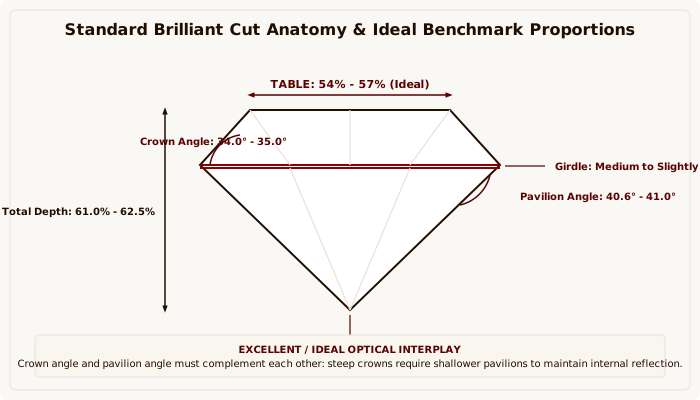
Figure 3.1: Anatomy of a Brilliant Cut Diamond (Table, Crown, Pavilion, Girdle, Culet)
The Genesis of the 4Cs Standard
Prior to the mid-20th century, the global diamond trade utilized vague, subjective terminology to describe diamond quality—terms such as "river," "wesselton," "top crystal," and "clean." In the 1940s and 1950s, the Gemological Institute of America (GIA) established the 4Cs Diamond Grading System, creating a precise, standardized international nomenclature.
Today, the International Gemological Institute (IGI)—which grades the overwhelming majority of certified lab-grown diamonds globally—and the GIA grade lab stones under identical gemological protocols. Whether a crystal originated in the Earth’s mantle or an MPCVD reactor, it is subjected to the exact same 4Cs testing and microscope analysis.
1. Cut: The Engine of Diamond Brilliance
Of all the 4Cs, Cut exerts the greatest influence on a diamond’s beauty and light performance. While color and clarity are determined by crystal growth kinetics, cut is governed exclusively by human craftsmanship and faceting precision.
Cut grade does not refer to the diamond’s silhouette shape (such as round, oval, or pear). Rather, it evaluates the proportional angles and mathematical symmetry of the facets:
Brightness (Brilliance): White light reflected from the surface and interior of the diamond.
Fire (Dispersion): Spectral flashes of rainbow color caused by light refraction through facet prisms.
Scintillation: Dynamic pattern of light and dark flashes visible when the diamond or light source moves.
Grading tiers for Round Brilliant cuts range from Ideal / Excellent down to Very Good, Good, Fair, and Poor. In the B2B wholesale sector, Lavish recommends stocking strictly Ideal and Excellent cut stones to ensure maximum client satisfaction and showroom impact.
2. Color: The D-to-Z Purity Spectrum
The gemological color scale measures the absence of body color in white diamonds, starting with D (completely colorless) and progressing down the alphabet to Z (light yellow or brown tint):
Colorless (D – F)
Completely devoid of visible tint. Displays pure icy whiteness. Ideal for platinum and white gold settings.
Near Colorless (G – J)
Appears visually white face-up to untrained eyes. Offers outstanding commercial value for fine jewelry lines.
Faint / Warm (K – M)
Subtle warm yellowish or brownish hue, best paired with yellow gold or rose gold vintage mountings.
Because the vast majority of lab-grown diamonds are Type IIa (devoid of nitrogen impurities), they routinely achieve premium D, E, and F colorless grades at wholesale price points accessible to fine jewelry ateliers.
3. Clarity: Evaluating Microscopic Inclusions
Clarity evaluates the visual purity of a diamond under 10x optical magnification. Diamonds with zero inclusions or surface blemishes at 10x are graded Flawless (FL), while those with readily visible imperfections receive Included (I) grades:
FL / IF (Flawless / Internally Flawless): Zero inclusions visible under 10x magnification. Extremely rare museum tier.
VVS1 / VVS2 (Very, Very Slightly Included): Minute inclusions extremely difficult to locate even for master gemologists under 10x loupe.
VS1 / VS2 (Very Slightly Included): Minor inclusions (microscopic pinpoints or faint feathers) visible under 10x magnification, but 100% invisible to the unaided human eye. This is the global B2B commercial sweet spot.
SI1 / SI2 (Slightly Included): Noticeable inclusions under 10x loupe; SI1 is typically eye-clean, while SI2 may show faint inclusions face-up upon close inspection.
I1 / I2 / I3 (Included): Inclusions clearly visible to the naked eye that may impair brilliance or structural integrity.
4. Carat: Physical Weight vs. Visual Spread
Carat is a measure of physical mass: 1.00 carat equals exactly 0.200 grams (200 milligrams). Each carat is divided into 100 "points" (e.g., a 0.50 ct diamond is a 50-pointer).
However, professional B2B diamond buyers understand that carat weight does not equal visual size. A diamond cut too deeply will hide carat weight in its pavilion, appearing smaller face-up than a properly proportioned stone of lower carat weight. For instance, an ideal-cut 1.00 ct Round Brilliant diamond measures approximately 6.50 mm in diameter. If a 1.00 ct round stone measures only 6.10 mm, it is cut too steep and lacks optimal light return.
B2B Inventory Optimization Strategy
For retail jewelry stores and manufacturing ateliers, selecting inventory that balances commercial margin with consumer appeal is vital:
The Lavish Recommended Inventory Profile
Cut: Strictly Ideal / Excellent (Never compromise on cut). Color: D, E, F (Colorless) for premium solitaires; G, H (Near Colorless) for value-conscious clients. Clarity: VS1 and VS2 (Guaranteed 100% eye-clean, delivering optimal visual beauty without paying the Flawless premium). Fluorescence: None.
help
Frequently Asked Questions
Which of the 4Cs is most important when buying lab diamonds?expand_more
Cut is undeniably the most important. A superior cut maximizes brilliance, scintillation, and fire. Because lab diamonds are substantially more affordable than mined stones, buyers should never compromise on Cut—always select Ideal or Excellent cut grades.
Is a VVS clarity diamond noticeably more brilliant than a VS diamond?expand_more
No. Both VVS and VS clarity grades are completely eye-clean. The inclusions in a VS diamond are microscopic and invisible without 10x magnification. Brilliance is determined by Cut proportions, not by microscopic clarity differences.
Why does a 2.00-carat diamond cost more than two 1.00-carat diamonds?expand_more
Diamond valuation follows an exponential carat curve. Growing larger single crystals requires longer continuous synthesis runs and higher risk of reactor failure. Consequently, price per carat increases with carat weight.
verified
Lavish Gemological & Technical Research Team
Technical Review: Senior Diamond Technologist & Quality Director
While lab diamonds achieve remarkable purity, understanding the nuances of color undertones and internal inclusion morphology is essential for discerning diamond buyers and wholesale quality controllers.
A diamond is an intricate optical prism. When light enters a diamond cut with mathematically ideal proportions, total internal reflection directs 100% of light back through the crown to the viewer’s eye, generating maximum fire and brilliance.
In jewelry benchwork and wholesale mounting, millimeters matter far more than carat weight. A setting is engineered to accommodate physical millimeter tolerances, not carats. Here is the definitive carat-to-mm conversion reference across all major diamond cuts.