How to Buy Lab-Grown Diamonds Wholesale: B2B Sourcing Playbook
verified
Lavish Gemological & Technical Research Team schedule
9 min read event
Last Updated: October 2026
Navigating the global wholesale diamond market requires understanding commercial trade structures, pricing mechanics, and logistics. From single certified solitaires to high-volume calibrated parcel orders, here is how retail jewelers, private designers, and manufacturing houses maximize margin and supply security.
lightbulbKey Gemological Takeaways
Procurement Models: Choosing between individual certified single stones, layout pairs, and bulk millimeter-calibrated parcels.
Direct-from-Manufacturer Pricing: Sourcing directly from Surat cutting houses eliminates 25%–40% broker markups.
Memo Terms vs. Outright Purchase: Weighing consignment flexibility against cash discounts and maximum margin capture.
Cross-Border Logistics: Shipping loose diamonds via secure armored transit (Brink’s, Malca-Amit, Ferrari Express) with full Lloyd’s underwriting.
Harmonized Tariff Codes (HS): Classifying loose lab diamonds under HS Code 7104.91 for smooth international customs clearance.
In wholesale diamond procurement, buyers typically acquire inventory through three distinct ordering channels:
Individual Certified Single Stones: Loose diamonds (typically 0.70 ct to 10.00+ ct) accompanied by an individual IGI or GIA grading certificate. Purchased for custom engagement ring commissions or high-value showroom showcase displays. Every stone is tracked by certificate number.
Calibrated Layout Pairs: Matched pairs of identical shape, millimeter dimensions (+/- 0.05 mm), color, and cut proportions, prepared specifically for stud earrings, three-stone rings, and cufflink sets.
Millimeter-Calibrated Parcels: Bulk lots of star and melee diamonds (0.80 mm to 3.80 mm) sorted by sieve plates and optical gauges into uniform millimeter increments, used for pavé bands, eternity rings, and watch bezels.
Unlike natural mined diamonds, which have historically traded at discounts or premiums off the Rapaport Diamond Report price list, lab-grown diamond wholesale pricing is governed by direct manufacturing economics:
Price-Per-Carat (PPC): Single certified stones are priced per carat based on the specific 4Cs grade combination. PPC scales with carat weight (e.g., a 3.00 ct stone commands a higher PPC than a 1.00 ct stone due to longer synthesis runs).
Volume Discounts: Parcels purchased in 50-carat or 100-carat lots receive tier discounts, significantly reducing unit costs for manufacturing jewelers.
Manufacturer-Direct Advantage: Sourcing directly from cutting centers like Lavish in Surat, India bypasses multiple layers of intermediate regional distributors, saving ateliers between 25% and 40%.
Outright Cash Purchase vs. Consignment Memo Terms
Jewelry businesses must balance capital liquidity with gross profit margins:
Outright Purchase (Net-30 / COD)
The jeweler buys the inventory outright. Offers the lowest wholesale price per carat, captures maximum retail gross margin (typically 200%–300% markup), and guarantees immediate stone availability for walk-in clients.
Consignment (Memo Terms)
The supplier places stones in the jeweler’s showcase on loan (memo) for a defined period (e.g., 7–14 days). Reduces inventory holding risk for rare sizes or high carats, but carries a higher cost-per-carat.
International diamond shipments must comply with strict trade regulations and security protocols:
Secure Transit Couriers: High-value parcels are transported via armored courier services such as Brink’s, Malca-Amit, or Ferrari Express, or through specialized high-value divisions of FedEx/UPS with third-party Lloyd’s of London transit insurance.
Harmonized System (HS) Code: Under the World Customs Organization classification, synthetic/lab-grown diamonds are formally classified under HS Code 7104.91 ("Synthetic or reconstructed diamonds, worked"). Correct tariff classification avoids customs delays and unexpected duty assessments.
Documentation Requirements: Every international parcel must include an itemized Commercial Invoice, Packing List, Country of Origin Declaration, and original IGI/GIA certificates.
The B2B Diamond Buyer’s Intake Checklist
Before finalizing a wholesale purchase order, ensure your supplier provides:
Official IGI or GIA digital certificate numbers cross-verifiable online.
Clear high-resolution 360-degree video scans of single stones showing facet light performance.
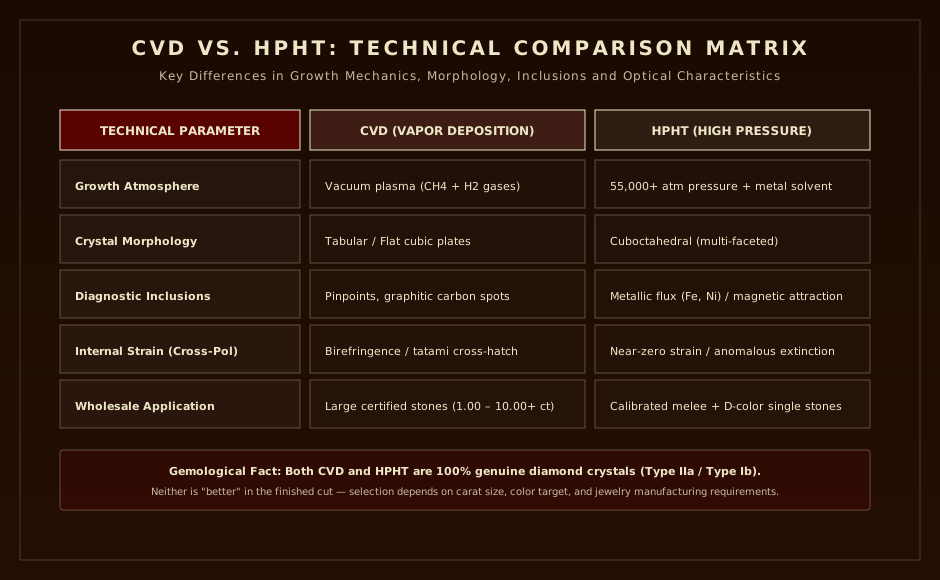
Explicit disclosure of growth method (CVD or HPHT) and confirmation of Type IIa status.
Definite return and exchange policy (typically 7 to 14 days) allowing physical intake inspection.
Calibrated millimeter verification on melee parcels to ensure seamless mounting compatibility.
help
Frequently Asked Questions
What is the minimum order quantity (MOQ) for wholesale at Lavish?expand_more
For certified single stones, there is no MOQ—jewelers can order individual single stones as needed for custom client orders. For calibrated melee, our MOQ starts at 5.00 carats per calibrated millimeter size.
How long does international shipping take?expand_more
Direct armored air courier shipments from our synthesis and cutting hub in Surat, India to the United States, Europe, Australia, and the UAE typically arrive within 3 to 5 business days, fully insured door-to-door.
Can Lavish provide custom layout pairs for earrings and multi-stone rings?expand_more
Yes. Our gemologists specialize in hand-matching layout pairs for length, width, table percentage, and color tone to ensure flawless symmetry in finished fine jewelry.
verified
Lavish Gemological & Technical Research Team
Technical Review: Senior Diamond Technologist & Quality Director
Selecting the right diamond supplier is the single most important strategic decision for a jewelry brand. Learn how to distinguish genuine primary manufacturers from middlemen brokers, evaluate cutting craftsmanship, and secure dependable inventory pipelines.
Flawless quality control is the backbone of luxury diamond commerce. This comprehensive guide outlines the professional multi-point intake protocol used by leading jewelry houses to verify incoming diamond parcels, measure tolerances, and catch defects before stones enter production.
In fine watchmaking and micro-pavé jewelry manufacturing, calibrated star and melee diamonds provide the luminous foundation. Learn how precision sieve sorting, millimeter tolerances, and color/clarity parcel grading streamline high-volume production.