Calibrated Star and Melee Diamonds: Sieve Sizing and Pavé Selection
verified
Lavish Gemological & Technical Research Team schedule
8 min read event
Last Updated: October 2026
In fine watchmaking and micro-pavé jewelry manufacturing, calibrated star and melee diamonds provide the luminous foundation. Learn how precision sieve sorting, millimeter tolerances, and color/clarity parcel grading streamline high-volume production.
lightbulbKey Gemological Takeaways
Star vs. Melee Definitions: "Stars" refer to small diamonds under 0.02 ct (0.80 mm to 1.80 mm); "Melee" encompasses stones from 0.02 ct to 0.20 ct (1.80 mm to 3.80 mm).
Sieve Plate Sizing Mechanics: Uses standardized stacked brass sieve plates with circular laser-cut apertures calibrated from -000 to +14.
Micro-Pavé Setting Tolerances: Requires strict millimeter calibration (+/- 0.025 mm) to prevent uneven prong seating and stone popping.
Color & Clarity Parcel Consistency: Guaranteed D-F / VVS-VS uniformity across 100+ carat parcel orders to ensure uniform reflection on eternity bands.
HPHT Synthesis Superiority in Melee: HPHT produces strain-free cuboctahedral crystals ideal for precision round cutting at scale.
In diamond manufacturing terminology, small loose diamonds used in halos, channel bands, micro-pavé, and Swiss watch bezels are categorized by weight into two distinct industry classes:
Star Diamonds: Extremely small brilliant-cut diamonds weighing from 0.005 ct up to 0.02 ct (roughly 0.80 mm to 1.80 mm in diameter). Each tiny stone possesses a full 57 facets.
Melee Diamonds: Small diamonds weighing from 0.02 ct up to 0.20 ct (roughly 1.80 mm to 3.80 mm in diameter). Stones larger than 0.20 ct are classified as pointers.
Because weighing thousands of individual 0.01-carat stones is commercially impossible, the wholesale diamond trade sorts and trades melee exclusively using standardized sieve plates.
How Diamond Sieve Plates Work
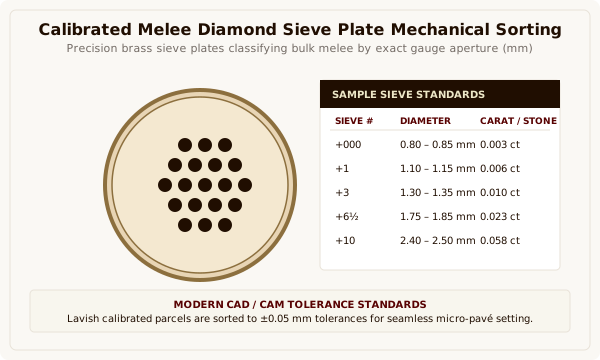
A diamond sieve set consists of a nesting stack of circular brass or stainless-steel plates, each perforated with hundreds of laser-cut circular apertures. Sieve numbers are designated with plus (+) and minus (-) symbols:
A "-2" notation means the diamonds pass through the size 2 sieve plate.
A "+2" notation means the diamonds are retained on top of the size 2 sieve plate.
A parcel designated as "+2 / -3" contains stones that fell through sieve #3 but were caught by sieve #2, guaranteeing a tightly calibrated diameter window (typically 1.30 mm to 1.40 mm).
Sieve Number to Millimeter & Carat Conversion Table
Sieve Size
Diameter Range (mm)
Approx. Carats per Stone
Stones per Carat (SPC)
-000
0.80 – 0.90 mm
0.003 – 0.004 ct
250 – 300 SPC
000 to 00
0.90 – 1.05 mm
0.005 ct
200 SPC
+0 to +1
1.10 – 1.20 mm
0.007 ct
140 – 150 SPC
+2 to +3
1.30 – 1.40 mm
0.010 ct (1 point)
100 SPC
+4 to +5
1.50 – 1.60 mm
0.015 ct (1.5 pts)
65 – 70 SPC
+6 to +6.5
1.70 – 1.85 mm
0.020 – 0.025 ct
40 – 50 SPC
+8 to +8.5
2.00 – 2.15 mm
0.035 – 0.040 ct
25 – 30 SPC
+10 to +11
2.40 – 2.50 mm
0.055 – 0.060 ct
16 – 18 SPC
+13 to +14
2.90 – 3.10 mm
0.10 ct (10 points)
10 SPC
Quality Standards for Micro-Pavé & Watch Dials
In micro-pavé setting, a master setter drills tiny conical seats into gold or platinum, placing dozens of melee diamonds side-by-side held only by microscopic bead prongs raised from the base metal. If diamond diameters vary by even 0.05 mm, severe manufacturing defects occur:
Oversized stones force the setter to recut seats, slowing production.
Undersized stones sit loose, resulting in popped or lost stones under daily wear.
Uneven heights disrupt the flat mirror reflection across eternity bands.
Lavish calibrated melee parcels undergo secondary digital optical gauge sorting, guaranteeing dimensional consistency to within +/- 0.025 mm.
B2B Parcel Procurement: Color & Clarity Grading Consistency
Unlike large certified solitaires which come with individual IGI certificates, melee parcels are ordered and certified by the batch. At Lavish, our calibrated parcels are categorized into standardized wholesale quality tiers:
Collection Quality (D-F / VVS-VS)
The premier choice for luxury Swiss watchmakers and high-jewelry maisons. 100% colorless, flawless face-up scintillation, and zero strain.
Commercial Fine (G-H / VS-SI)
The workhorse tier for bridal engagement halos and fashion eternity rings. Beautiful, bright white appearance delivering optimal gross margins.
help
Frequently Asked Questions
Do melee diamonds come with individual certificates?expand_more
No. Because testing and grading an individual 0.01-carat diamond would cost more than the stone itself, melee diamonds are graded and certified by the parcel batch (e.g. 100-carat lot certification).
What does "Stones Per Carat" (SPC) mean?expand_more
Stones Per Carat (SPC) is the diamond trade standard for expressing melee size. For example, "100 SPC" means 100 diamonds together weigh approximately 1.00 carat (averaging 0.01 ct or 1 point per stone).
What is the minimum order quantity for calibrated melee at Lavish?expand_more
Lavish supplies calibrated melee parcels starting from 5.00 carats up to multi-thousand carat production contracts, calibrated to exact millimeter requirements.
verified
Lavish Gemological & Technical Research Team
Technical Review: Senior Diamond Technologist & Quality Director
In jewelry benchwork and wholesale mounting, millimeters matter far more than carat weight. A setting is engineered to accommodate physical millimeter tolerances, not carats. Here is the definitive carat-to-mm conversion reference across all major diamond cuts.
Diamond shape defines the architectural silhouette, facet geometry, and personal aesthetic of a gemstone. From the classic 57-facet Round Brilliant to the geometric step cuts of Emerald and Asscher, explore the technical specifications and ideal ratios of all 12 major diamond cuts.
Navigating the global wholesale diamond market requires understanding commercial trade structures, pricing mechanics, and logistics. From single certified solitaires to high-volume calibrated parcel orders, here is how retail jewelers, private designers, and manufacturing houses maximize margin and supply security.