Diamond Carat Weight vs. Millimeter Size: Conversion and Sizing Chart
verified
Lavish Gemological & Technical Research Team schedule
8 min read event
Last Updated: October 2026
In jewelry benchwork and wholesale mounting, millimeters matter far more than carat weight. A setting is engineered to accommodate physical millimeter tolerances, not carats. Here is the definitive carat-to-mm conversion reference across all major diamond cuts.
lightbulbKey Gemological Takeaways
Mass vs. Dimension: 1.00 carat is 0.200 grams, but face-up dimensions vary drastically depending on shape geometry and cutting depth.
The Elongated Spread Advantage: Marquise, Pear, and Oval cuts offer up to 15% larger surface area per carat than Round Brilliants.
Avoiding Hidden Carat Weight: Deeply cut stones conceal carat weight in the pavilion, causing a 1.50 ct stone to look like a 1.25 ct stone face-up.
Mounting Calibration: Pre-fabricated ring prongs and cast bezel settings require precise millimeter tolerances (+/- 0.05 mm) to avoid stone loose play or breakage.
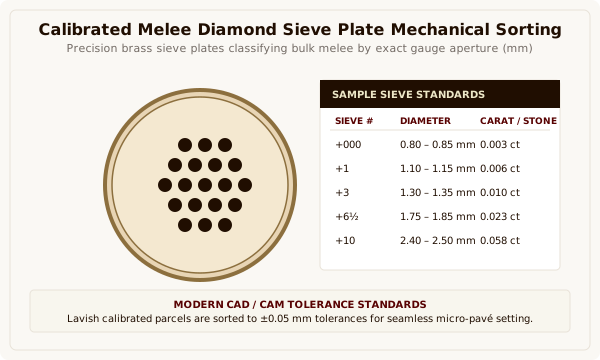
Calibrated Melee Sizing: Star and melee diamonds smaller than 0.20 ct are ordered exclusively by millimeter sieves rather than individual carat weight.
Figure 3.4: Precision Sieve Plate Calibration System for Melee Diameters (0.80mm to 3.50mm)
Carat Weight vs. Face-Up Millimeter Spread
One of the most frequent mistakes made by consumers and novice buyers is assuming that doubling the carat weight doubles the visible size of the diamond. In reality, diamond mass is distributed three-dimensionally across volume:
Therefore, doubling the weight from 1.00 ct (6.50 mm diameter) to 2.00 ct increases the diameter to approximately 8.10 mm—a 25% increase in diameter and roughly a 55% increase in face-up surface area, not 100%.
The following reference chart illustrates ideal millimeter diameters for standard Round Brilliant cut diamonds:
Carat Weight
Ideal Diameter (mm)
Average Face-Up Area (mm²)
Visual Spread Rating
0.50 ct
5.10 – 5.20 mm
20.8 mm²
Baseline
0.75 ct
5.80 – 5.90 mm
26.9 mm²
+29% vs 0.50 ct
1.00 ct
6.45 – 6.55 mm
33.2 mm²
+59% vs 0.50 ct
1.50 ct
7.35 – 7.45 mm
43.0 mm²
+30% vs 1.00 ct
2.00 ct
8.10 – 8.20 mm
52.2 mm²
+57% vs 1.00 ct
3.00 ct
9.25 – 9.35 mm
67.9 mm²
+105% vs 1.00 ct
4.00 ct
10.20 – 10.35 mm
82.5 mm²
+148% vs 1.00 ct
5.00 ct
11.00 – 11.15 mm
96.8 mm²
+191% vs 1.00 ct
Fancy Shapes Millimeter Reference Table (12 Cuts)
Average dimensions for 1.00 ct and 2.00 ct diamonds across major fancy cuts:
Diamond Shape
Ideal Ratio (L:W)
1.00 ct Dimensions (mm)
2.00 ct Dimensions (mm)
Round Brilliant
1.00 : 1.00
6.50 × 6.50 mm
8.15 × 8.15 mm
Oval Brilliant
1.35 – 1.45
7.70 × 5.50 mm
9.80 × 7.00 mm
Emerald Cut
1.40 – 1.50
6.80 × 4.80 mm
8.50 × 6.00 mm
Radiant Cut
1.20 – 1.30
6.00 × 5.00 mm
7.80 × 6.20 mm
Cushion (Modified)
1.00 – 1.15
6.00 × 5.50 mm
7.50 × 7.00 mm
Princess Cut
1.00 – 1.03
5.50 × 5.50 mm
7.00 × 7.00 mm
Pear Shape
1.50 – 1.65
8.50 × 5.40 mm
10.8 × 7.00 mm
Marquise Cut
1.85 – 2.05
10.2 × 5.00 mm
13.0 × 6.50 mm
Asscher Cut
1.00 – 1.04
5.50 × 5.50 mm
7.00 × 7.00 mm
Jewelry Benchwork & Setting Tolerances
For jewelry manufacturers ordering loose diamond inventory for pre-cast mountings:
Prong Settings: Allow tolerances of +/- 0.10 mm. Prongs can be gently adjusted outward or inward.
Bezel & Halo Settings: Require strict tolerances of +/- 0.05 mm. An oversized stone will not seat into the bezel seat, while an undersized stone will show unsightly gaps around the metal rim.
Channel & Pavé Settings: Require calibrated sieve sorting. Even a 0.05 mm variation in melee diameter can disrupt line symmetry and cause uneven prong tension.
help
Frequently Asked Questions
Which diamond shape looks the biggest per carat?expand_more
Marquise, Oval, and Pear cuts appear the largest face-up per carat. Their elongated profiles distribute weight across a larger surface area, appearing up to 15% larger face-up than a Round Brilliant of identical carat weight.
Why does a Princess cut look smaller face-up than a Round diamond?expand_more
Princess cuts have deep corner pavilions and sharp pyramid bases where more weight is concentrated vertically. A 1.00 ct Princess cut measures approximately 5.50 mm, while a 1.00 ct Round measures 6.50 mm.
Can I order diamonds based on exact millimeter dimensions from Lavish?expand_more
Yes. Lavish specializes in millimeter-calibrated parcel sorting for manufacturers, ensuring exact stone dimensions for production cast settings and eternity bands.
verified
Lavish Gemological & Technical Research Team
Technical Review: Senior Diamond Technologist & Quality Director
The universal language of diamond quality is the 4Cs—Cut, Color, Clarity, and Carat Weight. Established by the GIA and adopted globally by IGI, the 4Cs apply with equal scientific rigor to lab-grown diamonds, governing both visual brilliance and wholesale commercial value.
A diamond is an intricate optical prism. When light enters a diamond cut with mathematically ideal proportions, total internal reflection directs 100% of light back through the crown to the viewer’s eye, generating maximum fire and brilliance.
In fine watchmaking and micro-pavé jewelry manufacturing, calibrated star and melee diamonds provide the luminous foundation. Learn how precision sieve sorting, millimeter tolerances, and color/clarity parcel grading streamline high-volume production.