Diamond Cut Proportions, Angles, and Light Performance Guide
verified
Lavish Gemological & Technical Research Team schedule
9 min read event
Last Updated: October 2026
A diamond is an intricate optical prism. When light enters a diamond cut with mathematically ideal proportions, total internal reflection directs 100% of light back through the crown to the viewer’s eye, generating maximum fire and brilliance.
lightbulbKey Gemological Takeaways
Cut Governs Sparkle: Proportions and angles dictate whether light escapes out the pavilion (light leakage) or returns to the eye (total internal reflection).
The Marcel Tolkowsky Benchmark: Established in 1919, Tolkowsky’s mathematical model defined the ideal 57-facet Round Brilliant cut proportions.
The Critical Angles: Crown angle (34.0°–35.0°) and Pavilion angle (40.6°–40.8°) form the critical optical pairing for Round Brilliants.
Table and Depth Parameters: Ideal Table percentage: 54%–57%; Ideal Total Depth percentage: 61.0%–62.5%.
Hearts and Arrows Precision: Optical symmetry test confirming perfect 8-fold facet alignment under specialized red-blue reflector viewers.
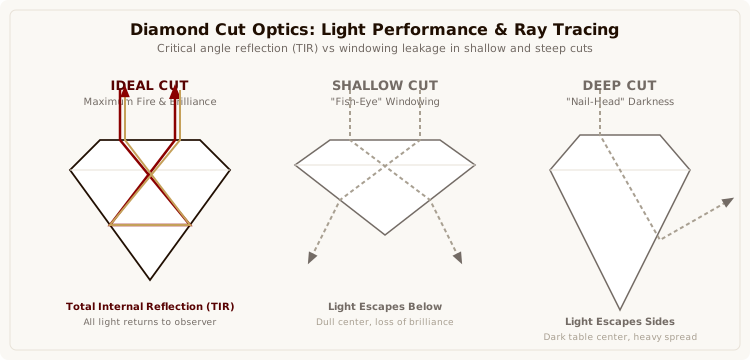
Figure 3.3: Ray Tracing Optical Physics: Ideal Cut (Total Internal Reflection) vs. Shallow Cut (Windowing) vs. Deep Cut (Nailhead)
The Optical Physics of Total Internal Reflection
Diamond has an exceptionally high refractive index of n = 2.417. According to Snell’s Law of Refraction, when light passes from diamond into air, the critical angle ($\theta_c$) is given by:
\(\theta_c = \arcsin(1 / 2.417) = 24.4^\circ\)
This remarkably small critical angle means that any light ray striking an internal diamond facet at an angle greater than 24.4° is 100% internally reflected rather than refracted outward. A master cutter aligns the pavilion facets like internal mirrors, reflecting incident light across the base of the diamond and projecting it straight back through the crown and table facets into the observer’s eye.
Ideal Proportions for Round Brilliant Diamonds
In 1919, mathematician and gemologist Marcel Tolkowsky published his landmark treatise Diamond Design, establishing the mathematical parameters for optimal light return in a 57-facet Round Brilliant diamond. Modern gemological laboratories (IGI Ideal and GIA Excellent) operate within tightly defined proportion envelopes:
Cut Parameter
Ideal / Super-Ideal Range
GIA / IGI Excellent Range
Table Percentage
54.0% – 57.0%
53.0% – 58.0%
Total Depth Percentage
61.0% – 62.5%
59.0% – 63.0%
Crown Angle
34.0° – 35.0°
33.0° – 35.5°
Pavilion Angle
40.6° – 40.8°
40.4° – 41.2°
Girdle Thickness
Medium to Slightly Thick (Facetted)
Thin to Slightly Thick
Culet Size
None (Pointed)
None to Very Small
Cut Flaws: The Shallow "Fish-Eye" vs. Deep "Nail-Head"
When a diamond is faceted with incorrect pavilion angles, light performance collapses:
Shallow Cut (Windowing / "Fish-Eye"): When the pavilion angle is too flat (< 39.5°), incoming light strikes the pavilion facets at an angle below 24.4°. Instead of reflecting, light passes straight through the bottom like a window pane. The stone appears dull, washed out, and displays a circular gray ring reflection around the table.
Deep Cut ("Nail-Head"): When the pavilion angle is cut too steep (> 42.0°), light reflects across to the opposite pavilion facet at an improper angle and shoots out the side base of the stone. The center of the diamond appears dark and lifeless, resembling a black nail head. Furthermore, deep cuts waste carat weight in the hidden bottom of the setting.
Hearts & Arrows Super-Ideal Optical Symmetry
A standard "Excellent" cut grade evaluates two-dimensional proportions and overall symmetry. However, Hearts & Arrows (H&A) represents an elite tier of three-dimensional optical symmetry.
When viewed through a specialized red-blue reflector loupe:
Viewed table-up (face-up): Displays eight symmetrical, razor-sharp light arrows radiating from the center.
Achieving Hearts & Arrows precision requires master diamond cutters to sacrifice an additional 12% to 15% of rough diamond weight, resulting in unmatched scintillation and light synchronization across all 57 facets.
Evaluating Cut in Fancy Shapes (Oval, Emerald, Radiant)
Unlike Round Brilliants, gemological laboratories (such as IGI and GIA) do not assign official cut grades (e.g. "Ideal" or "Excellent") to fancy diamond shapes. Instead, grading reports list only Polish and Symmetry grades.
Evaluating cut in fancy shapes requires examining proportions and physical visual characteristics:
Oval, Pear, and Marquise: Scrutinized for the bow-tie effect—a dark shadow across the center caused by light leaking through the pavilion. A well-cut oval displays a balanced, bright center without an obstructive dark bow-tie.
Emerald & Asscher (Step Cuts): Evaluated for parallel step symmetry and concentric "hall-of-mirrors" reflections. Optimal depth percentage is between 64% and 72%.
Radiant & Cushion: Evaluated for edge-to-edge brilliant scintillation without "crushed ice" muddiness or dark corners.
help
Frequently Asked Questions
Why does IGI give an Ideal cut grade while GIA only goes up to Excellent?expand_more
IGI includes an "Ideal" cut tier for stones meeting the absolute strictest proportion and light performance standards, whereas GIA’s highest cut grade for round brilliants is "Excellent". In practice, an IGI Ideal cut corresponds to the top tier of GIA Excellent.
Can a diamond have an Excellent cut grade but still look dull?expand_more
Yes, if the crystal contains severe internal strain, dense clouds, or muddy color undertones. This is why Lavish combines strict cut proportion filtering with physical gemological inspection.
What is the bow-tie effect in elongated diamond cuts?expand_more
The bow-tie effect is a dark, bow-tie-shaped shadow across the center of elongated cuts (Ovals, Pears, Marquises) caused by facet misalignment. While all elongated cuts have a subtle bow-tie, master cutting minimizes it so light reflects brightly across the entire stone.
verified
Lavish Gemological & Technical Research Team
Technical Review: Senior Diamond Technologist & Quality Director
The universal language of diamond quality is the 4Cs—Cut, Color, Clarity, and Carat Weight. Established by the GIA and adopted globally by IGI, the 4Cs apply with equal scientific rigor to lab-grown diamonds, governing both visual brilliance and wholesale commercial value.
In jewelry benchwork and wholesale mounting, millimeters matter far more than carat weight. A setting is engineered to accommodate physical millimeter tolerances, not carats. Here is the definitive carat-to-mm conversion reference across all major diamond cuts.
Diamond shape defines the architectural silhouette, facet geometry, and personal aesthetic of a gemstone. From the classic 57-facet Round Brilliant to the geometric step cuts of Emerald and Asscher, explore the technical specifications and ideal ratios of all 12 major diamond cuts.