What Are Lab-Grown Diamonds? The Complete Scientific and Gemological Guide
verified
Lavish Gemological & Technical Research Team schedule
8 min read event
Last Updated: October 2026
A lab-grown diamond is 100% pure crystallized carbon arranged in an isometric-hexoctahedral crystal system. Physically, chemically, and optically identical to mined diamonds, lab diamonds are synthesized under meticulously controlled laboratory conditions replicating Earth’s mantle.
lightbulbKey Gemological Takeaways
Identical Atomic Architecture: Possesses the exact same sp3 tetrahedral carbon crystal lattice as earth-mined diamonds.
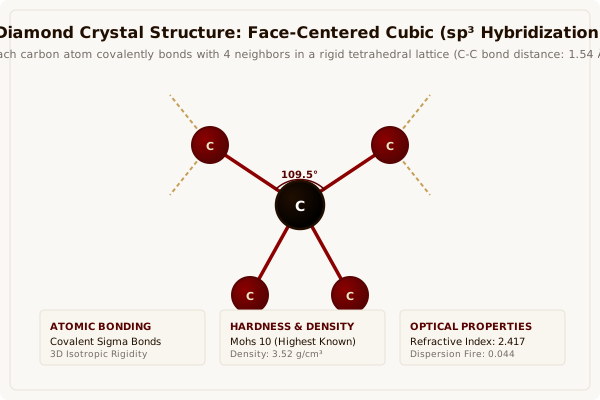
Uncompromised Physical Constants: Exact 10 Mohs hardness, 2.417 refractive index, 0.044 dispersion fire, and 3.52 g/cm³ specific gravity.
Superior Type IIa Purity: Over 98% of lab-grown diamonds qualify as Type IIa (the purest diamond typology containing negligible nitrogen), compared to less than 2% of mined stones.
Not Simulants: Distinct from diamond imitations such as Moissanite (silicon carbide) and Cubic Zirconia (zirconium dioxide); lab diamonds are real diamonds.
Official Regulatory Parity: Recognized as genuine diamonds by the US Federal Trade Commission (FTC), IGI, GIA, and international standards bodies.
At the atomic level, a lab-grown diamond is composed of pure elemental carbon atoms arranged in an isometric (cubic) crystal lattice. Each carbon atom forms four covalent bonds with neighboring carbon atoms via sp3 orbital hybridization, creating a rigid three-dimensional tetrahedral network. This specific lattice configuration features a unit cell parameter of a = 3.567 Å and a covalent bond length of 1.54 Å with uniform bond angles of 109.5°.
Because the covalent bonds between carbon atoms in the diamond crystal lattice are among the shortest and strongest chemical bonds in chemistry, diamond exhibits unmatched hardness, thermal conductivity, and chemical inertness. Crucially, whether this crystallization takes place 150 kilometers below the continental lithosphere or inside a precision Chemical Vapor Deposition (CVD) vacuum chamber, the resulting crystal structure is mathematically and physically identical.
Fundamental Physical & Optical Constants
To evaluate gemstone authenticity and performance, gemologists rely on fundamental physical constants. Certified lab-grown diamonds register exact 1:1 parity with natural diamonds across every scientific measurement:
Hardness (Mohs)
10.0
Highest on Mohs scale; scratches all other minerals.
Refractive Index
2.417
Single refractive (isotropic); governs total internal reflection.
Dispersion Fire
0.044
B-G chromatic dispersion producing spectral fire flashes.
Thermal Conductivity
2000 W/m·K
5x higher than copper; allows instant heat dissipation.
Because of diamond’s extreme thermal conductivity and high refractive index, standard electronic diamond testers—which measure rate of heat dissipation and electrical conductivity—respond to lab-grown diamonds in the exact same manner as mined diamonds. Standard jeweler testing instruments confirm them as 100% diamond.
Lab Diamonds vs. Diamond Simulants (CZ & Moissanite)
A critical distinction must be made between lab-grown diamonds (genuine crystallized carbon) and diamond simulants (materials engineered to resemble diamonds visually but possessing entirely different chemical and physical properties).
Property
Lab-Grown Diamond
Moissanite
Cubic Zirconia (CZ)
White Sapphire
Chemical Composition
Pure Carbon (C)
Silicon Carbide (SiC)
Zirconium Dioxide (ZrO₂)
Aluminum Oxide (Al₂O₃)
Mohs Hardness
10.0
9.25
8.0 – 8.5
9.0
Refractive Index (RI)
2.417 (Isotropic)
2.65 – 2.69 (Doubly Refractive)
2.15 – 2.18
1.76 – 1.77
Dispersion (Fire)
0.044 (Balanced)
0.104 (Disco-ball effect)
0.058 – 0.066
0.018 (Glassy)
Specific Gravity (g/cm³)
3.52
3.22
5.60 – 6.00 (Heavy)
3.98 – 4.06
Thermal Conductivity
~2000 W/m·K
~490 W/m·K
0.01 W/m·K (Thermal Insulator)
35 W/m·K
While Cubic Zirconia scratches easily over time and loses its luster due to its porous surface, and Moissanite exhibits pronounced optical double refraction ("rainbow disco-ball" facet doubling), lab-grown diamonds deliver the authentic, crisp single-refractive scintillation and enduring permanence that only 10-Mohs pure carbon can achieve.
Chemical Purity & Type IIa Classification
In gemology, diamonds are classified into scientific types based on the presence or absence of atomic nitrogen and boron impurities:
Type Ia (98% of mined diamonds): Contain aggregated nitrogen atoms (A-centers and B-centers) causing subtle yellowish or brownish body tint and optical absorption bands.
Type Ib (rare in nature): Contain isolated, single substitutional nitrogen atoms.
Type IIa (less than 2% of mined diamonds, over 98% of CVD lab diamonds): Contain virtually zero measurable nitrogen or boron impurities (< 1 part per million). Type IIa diamonds are renowned as the most optically pure diamonds in the world, exhibiting exceptional transparency and whiteness. Famous historical diamonds like the Cullinan and Koh-i-Noor are Type IIa diamonds.
Type IIb (extremely rare): Contain trace boron impurities, giving rise to natural semiconductor properties and fancy blue coloration.
Because the synthesis environment in modern CVD and HPHT diamond laboratories is strictly controlled with ultra-high purity gas mixtures, the vast majority of lab-grown diamonds achieve Type IIa certification, providing superior optical purity at wholesale price points accessible to jewelry ateliers.
In July 2018, the United States Federal Trade Commission (FTC) officially revised its Jewelry Guides, removing the word "natural" from the definition of a diamond. The FTC ruled that a diamond is defined by its chemical composition and physical properties—pure crystallized carbon in the isometric system—regardless of whether it crystallized within the Earth’s mantle or inside a laboratory reactor.
Today, the world’s leading gemological authorities—including the International Gemological Institute (IGI), Gemological Institute of America (GIA), and Hoge Raad voor Diamant (HRD Antwerp)—issue official diamond grading reports for lab-grown diamonds using the standardized 4Cs grading methodology. Every certified stone is microscopically laser-inscribed on its girdle with its unique report number and the laboratory disclosure, guaranteeing complete traceability and consumer transparency across global wholesale supply chains.
help
Frequently Asked Questions
Do lab-grown diamonds pass a standard diamond tester?expand_more
Yes. Standard thermal and electrical conductivity diamond testers identify lab-grown diamonds as genuine diamond because they possess the exact thermal conductivity (~2000 W/m·K) and electrical properties of natural diamonds. Differentiating lab diamonds requires advanced gemological laboratory equipment such as FTIR and photoluminescence spectroscopy.
Can a jeweler tell a lab diamond from a natural diamond with a loupe?expand_more
Under a standard 10x jeweler loupe or optical microscope, a cut and polished lab diamond cannot be distinguished from a natural diamond. The facet reflections, sparkle, and crystal structure are identical. The only visual cue is the microscopic laser inscription on the girdle reading "LAB GROWN" or "LG" followed by the certification number.
Will a lab-grown diamond fade, cloud, or change color over time?expand_more
Never. A lab-grown diamond is 100% pure carbon with a Mohs hardness of 10. It cannot cloud, fade, yellow, or degrade over time under any normal environmental conditions. It will retain its brilliance, fire, and polish indefinitely, exactly like an earth-mined diamond.
Are lab-grown diamonds graded on the same 4Cs scale as mined diamonds?expand_more
Yes. Major gemological laboratories like IGI and GIA grade lab-grown diamonds using identical criteria: Carat Weight, Color (D through Z), Clarity (Flawless to Included), and Cut Grade (Ideal, Excellent, Very Good, Good, Fair).
verified
Lavish Gemological & Technical Research Team
Technical Review: Senior Diamond Technologist & Quality Director
Scientific reality: natural and lab-grown diamonds are physically, chemically, and optically identical. Understanding the differences comes down to origin, formation timeline, environmental footprint, and commercial wholesale economics.
Both CVD and HPHT produce 100% genuine diamonds. However, their contrasting growth mechanics create distinct morphological traits, inclusion types, and internal strain profiles. Here is how professional wholesale buyers evaluate both synthesis methods.
The International Gemological Institute (IGI) is the global gold standard for lab-grown diamond certification. This comprehensive guide walks you through every data field on an official IGI report—from 4Cs grading to proportion diagrams and vital growth comments.