B2B Diamond Intake and Quality Control: Inspection Protocols
verified
Lavish Gemological & Technical Research Team schedule
9 min read event
Last Updated: October 2026
Flawless quality control is the backbone of luxury diamond commerce. This comprehensive guide outlines the professional multi-point intake protocol used by leading jewelry houses to verify incoming diamond parcels, measure tolerances, and catch defects before stones enter production.
lightbulbKey Gemological Takeaways
Standardized Receiving Station: Requires 5500K daylight-equivalent illumination, 10x/20x achromatic triplet loupe, digital caliper, and 3-decimal carat scale.
The 5-Step Physical QC Pipeline: Package integrity check, carat weight verification, digital dimension audit, girdle inscription read, and optical cleanliness inspection.
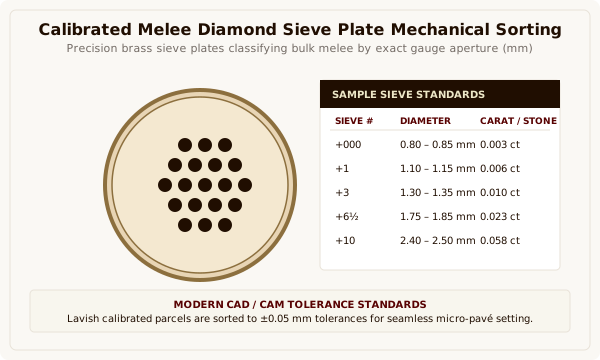
Melee Sieve Sample Audits: Performing random sample audits on 100-carat parcels using precision millimeter gauges to verify sizing tolerances.
Discrepancy Logging & Quarantine: Establishing a formal quarantine protocol for non-conforming stones to ensure seamless vendor returns.
Figure 6.3: Multi-Stage Diamond Intake & Quality Control Inspection Flowchart
Setting Up a Professional Gemological QC Station
Diamond quality inspection requires a controlled, standardized optical environment. Conducting inspections under arbitrary showroom spotlights or warm incandescent lamps distorts color and conceals inclusions. A professional QC bench must be equipped with:
Calibrated Daylight Lighting: A daylight-equivalent lamp producing 5500K to 6500K color temperature with a Color Rendering Index (CRI) of 95+.
Stereo Gemological Microscope: 10x to 45x continuous zoom magnification with darkfield, brightfield, and overhead fiber-optic illumination.
10x & 20x Achromatic Triplet Loupes: Corrected for spherical and chromatic aberrations.
Digital Non-Contact or Dial Calipers: Measuring dimensions to +/- 0.01 mm precision.
High-Precision Carat Scale: Calibrated to 0.001 carats (three decimal places).
Long-Wave & Short-Wave UV Chamber: For testing fluorescence and phosphorescence signatures.
The 5-Step Physical Intake Inspection Pipeline
When a shipment arrives, technicians follow a rigorous sequential protocol:
Step 1: Tamper-Evident Seal Inspection: Verify that courier security tape and vendor parcel seals are unbroken. Cross-check airway bill tracking against packing slips.
Step 2: Carat Weight Verification: Remove the loose stone and place it on a leveled, calibrated carat scale. The weight must match the certificate within +/- 0.005 carats.
Step 3: Dimensional Measurement: Measure maximum diameter, minimum diameter, and total depth with digital calipers. Record readings to two decimal places.
Step 4: Girdle Laser Inscription Read: Under 20x magnification, locate and read the microscopic laser inscription on the girdle, verifying exact alphanumeric match with the certificate.
Step 5: Face-Up Optical Inspection: Examine the stone face-up under 10x magnification for eye-clean status, verifying that no unmapped inclusions or dark spots affect visual brilliance.
Screening for Structural & Cutting Defects
Inspect the stone for subtle cutting or structural defects that could compromise jewelry setting:
Girdle Defects
Check for "knife-edge" (extremely thin) girdles prone to chipping under prong pressure, or "extremely thick" girdles that hide dead carat weight.
Culet & Facet Chips
Examine the culet point under 20x to ensure it has not been chipped during transit. Inspect facet junctions for abrasion or polishing drag lines.
Surface-Reaching Feathers
Ensure internal feather fractures do not break the surface at the girdle where setting tools apply mechanical torque.
Laser Sawing Scars
Verify that the girdle has been cleanly faceted or polished, with zero residual black graphite remnants from rough laser sawing.
Statistical Quality Control for Calibrated Melee Parcels
For bulk melee parcels (e.g., 50 carats containing over 2,000 stones), testing every stone is impossible. Professional QC teams utilize Statistical Acceptance Sampling (AQL 1.0 Standard):
Draw a random sample of 50 stones across different depths of the parcel paper.
Pass the sample through top and bottom calibration sieve plates to verify zero out-of-spec stones.
Measure 10 individual stones with a digital lever gauge to confirm diameter variance within +/- 0.025 mm.
Inspect the sample under 10x magnification: 100% of stones must meet the agreed color tier (e.g. D-F) and clarity tier (VVS-VS).
Discrepancy Management & Quarantine Procedures
If any non-conforming stone is identified:
Immediately place the stone in a red-coded "Quarantine" parcel envelope with a written discrepancy report (e.g., "Carat scale reads 2.01 ct vs 2.04 ct on cert" or "Chip observed on pavilion facet").
Capture high-magnification photomicrographs through the microscope eyepiece documenting the defect.
Notify the supplier’s account manager within the inspection window (typically within 48 hours of receipt) to initiate exchange or credit memo processing.
At Lavish, our pre-shipment quality audit eliminates these issues before orders depart, delivering pristine, verified inventory directly to your atelier.
help
Frequently Asked Questions
What is the most common reason diamond parcels are rejected during intake?expand_more
In calibrated melee parcels, the most common defect is diameter variance (stones exceeding +/- 0.05 mm tolerance). In single certified stones, common reasons include unappealing brownish undertones or misaligned laser inscriptions.
How can a jeweler test diamonds for fluorescence at the bench?expand_more
Use a standard dual-wave UV desktop box (365 nm long-wave). Diamonds with zero fluorescence remain completely inert, while fluorescent stones glow blue, yellow, or green under UV exposure.
Does Lavish inspect every stone before shipping?expand_more
Yes. Every certified single diamond and calibrated melee parcel dispatched by Lavish undergoes physical 4-point verification by our senior gemologists before entering tamper-evident packaging.
verified
Lavish Gemological & Technical Research Team
Technical Review: Senior Diamond Technologist & Quality Director
Navigating the global wholesale diamond market requires understanding commercial trade structures, pricing mechanics, and logistics. From single certified solitaires to high-volume calibrated parcel orders, here is how retail jewelers, private designers, and manufacturing houses maximize margin and supply security.
Selecting the right diamond supplier is the single most important strategic decision for a jewelry brand. Learn how to distinguish genuine primary manufacturers from middlemen brokers, evaluate cutting craftsmanship, and secure dependable inventory pipelines.
Trust in diamond commerce relies on verifiable chain-of-custody. Learn the 4-step intake protocol used by master gemologists and luxury ateliers to cross-reference an IGI grading report against the physical diamond in hand.