How to Verify an IGI Diamond Report and Laser Inscription
verified
Lavish Gemological & Technical Research Team schedule
8 min read event
Last Updated: October 2026
Trust in diamond commerce relies on verifiable chain-of-custody. Learn the 4-step intake protocol used by master gemologists and luxury ateliers to cross-reference an IGI grading report against the physical diamond in hand.
lightbulbKey Gemological Takeaways
The 4-Step Verification Protocol: 1. Digital Registry Lookup; 2. Microscopic Girdle Inspection; 3. Caliper Dimension Check; 4. Weight Audit.
Instant QR Authentication: Scan the printed report QR code with a smartphone camera to fetch the secure, immutable PDF from igi.org.
Laser Inscription Anatomy: The inscription measures mere microns in height, positioned on the girdle edge and viewable under 20x magnification.
Millimeter Precision Match: Non-contact optical calipers verify length, width, and depth to within +/- 0.02 mm of certificate specs.
Combating Switching Fraud: Catching switched stones or counterfeit certificates through weight-to-measurement mathematical ratios.
Figure 4.2: Four-Point Cross-Verification Framework: Certificate Database vs. Physical Diamond
The Professional 4-Point Intake Protocol
Whenever a wholesale parcel or loose certified diamond arrives at a jewelry manufacturer, retail store, or grading facility, it must undergo immediate receiving verification. Relying solely on a paper certificate without physically inspecting the stone exposes businesses to inventory errors and fraud.
At Lavish, our quality control technicians execute a standardized 4-Point Cross-Verification Protocol on every loose diamond before it enters active inventory:
1. Digital Registry Audit
Cross-check the report number directly against the laboratory’s live digital database via official API or QR scan.
2. Laser Inscription Match
Locate and read the micro-laser inscription on the girdle under 20x magnification to confirm exact number match.
3. Caliper Measurement
Measure physical length, width, and depth with digital dial calipers to ensure tolerances within +/- 0.02 mm.
4. Carat Balance Weighing
Weigh the loose stone on a calibrated 3-decimal carat scale to ensure exact weight agreement.
Step 1: Official IGI Online Database Lookup
Never rely solely on a printed paper certificate. Advanced high-resolution scanners and printers can produce convincing counterfeit paper documents. Always verify the certificate online:
Navigate directly to the official laboratory portal: igi.org/verify.
Enter the 10-digit IGI report number (e.g. 618392104).
Alternatively, scan the QR code located in the lower corner of the physical document using your smartphone camera.
Compare every field on the laboratory’s hosted digital PDF against your physical certificate: Carat weight, Color, Clarity, Cut, measurements, and date of issue must match 100%.
Step 2: Inspecting the Laser Inscription Under 20x
Certified lab-grown diamonds feature a microscopic laser inscription on the girdle edge. The inscription is typically etched using a cold ultraviolet laser that vaporizes a microscopic layer of carbon without causing thermal strain or cracking.
To inspect the inscription:
Secure the stone in diamond tweezers holding it table-to-culet.
Use a 10x or 20x achromatic triplet loupe or a stereo gemological microscope.
Rotate the stone along the girdle perimeter under diffused daylight or fiber-optic task lighting.
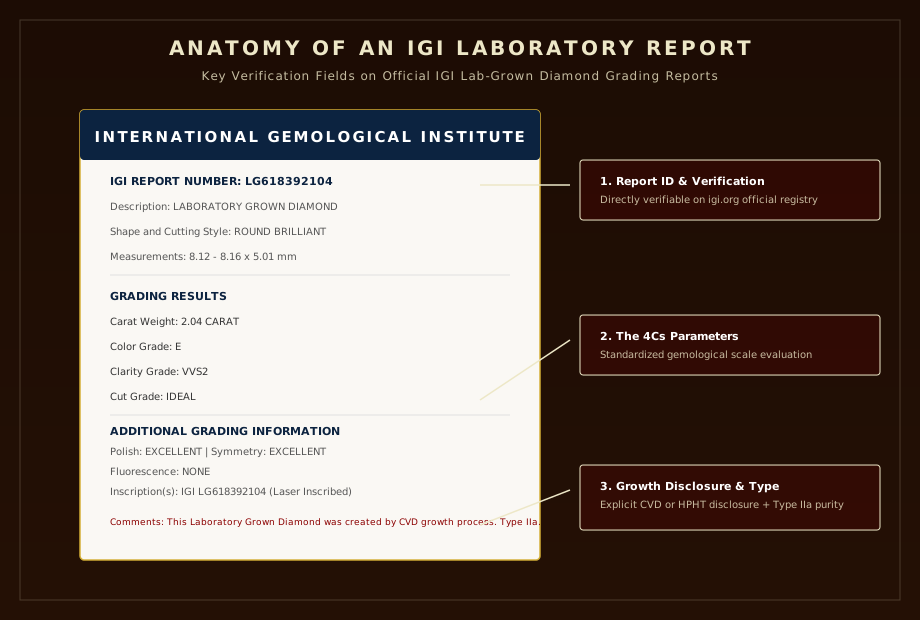
Read the inscription: It must display the laboratory logo or acronym followed by "LG" and the unique report number (e.g., LAB GROWN IGI LG618392104).
Step 3: Physical Dimensions & Carat Weight Audit
Once the certificate and laser inscription are verified, the physical stone must be audited against the certificate’s recorded physical constants:
Digital Caliper Check: Measure the minimum and maximum diameter, as well as the total depth from table to culet. Measurements must match the certificate to within +/- 0.02 mm.
Carat Scale Audit: Place the stone on a calibrated gemological balance. The reading must match the certificate’s carat weight to within 0.005 carats.
Because it is virtually impossible for two diamonds to share identical millimeter measurements to within 0.02 mm and identical weight down to a hundredth of a carat, this physical verification eliminates any possibility of stone switching.
Red Flags: Detecting Tampered Certificates or Switched Stones
Be alert to potential red flags when receiving diamond parcels:
Critical Red Flags to Reject
The online IGI database returns "Report Not Found" or shows conflicting carat/color details.
The laser inscription on the girdle looks crooked, hand-scratched, or lacks the crisp micro-dot font of genuine laboratory lasers.
Physical measurements deviate by more than 0.05 mm from the certificate specs.
The certificate lacks standard security watermarks, UV fluorescent threads, or micro-printed borders.
help
Frequently Asked Questions
Can a laser inscription be polished off a diamond?expand_more
Yes, a diamond cutter could theoretically polish off a micro-laser inscription from the girdle. However, doing so reduces the carat weight and alters the stone’s physical millimeter dimensions, which will no longer match the certificate.
Does the laser inscription hurt the diamond’s clarity grade?expand_more
No. Girdle laser inscriptions are microscopic and placed strictly on the perimeter edge. Gemological grading standards dictate that inscriptions do not affect the internal clarity grade of the stone.
Can I read the laser inscription with my naked eye?expand_more
No. The laser inscription font height is typically between 20 and 40 microns (smaller than a human hair). It requires at least 10x to 20x optical magnification to read.
verified
Lavish Gemological & Technical Research Team
Technical Review: Senior Diamond Technologist & Quality Director
The International Gemological Institute (IGI) is the global gold standard for lab-grown diamond certification. This comprehensive guide walks you through every data field on an official IGI report—from 4Cs grading to proportion diagrams and vital growth comments.
Because cut lab-grown diamonds share identical physical, optical, and thermal properties with mined diamonds, gemologists use advanced spectroscopy and deep-UV fluorescence imaging to definitively identify growth origin and protect trade integrity.
Flawless quality control is the backbone of luxury diamond commerce. This comprehensive guide outlines the professional multi-point intake protocol used by leading jewelry houses to verify incoming diamond parcels, measure tolerances, and catch defects before stones enter production.