Diamond Color and Clarity Grades in Lab-Grown Diamonds
verified
Lavish Gemological & Technical Research Team schedule
8 min read event
Last Updated: October 2026
While lab diamonds achieve remarkable purity, understanding the nuances of color undertones and internal inclusion morphology is essential for discerning diamond buyers and wholesale quality controllers.
lightbulbKey Gemological Takeaways
Color Grading Environment: Conducted in standardized GIA/IGI grading boxes under calibrated 5500K–6500K daylight-equivalent lighting against pure white backgrounds.
Subtle Undertones in Lab Stones: CVD diamonds can exhibit brown or gray undertones; HPHT diamonds can exhibit blue nuance if boron is present.
Taxonomy of Lab Inclusions: Pinpoints, graphite clouds, feathers, metallic flux needles, and growth zoning planes.
The Eye-Clean Standard: Defined as having zero inclusions visible to an unaided eye with 20/20 vision at a distance of 10–12 inches under diffused lighting.
Lavish Quality Filter: Every loose stone is physically verified to ensure crisp, icy whiteness free from undertone distortion.
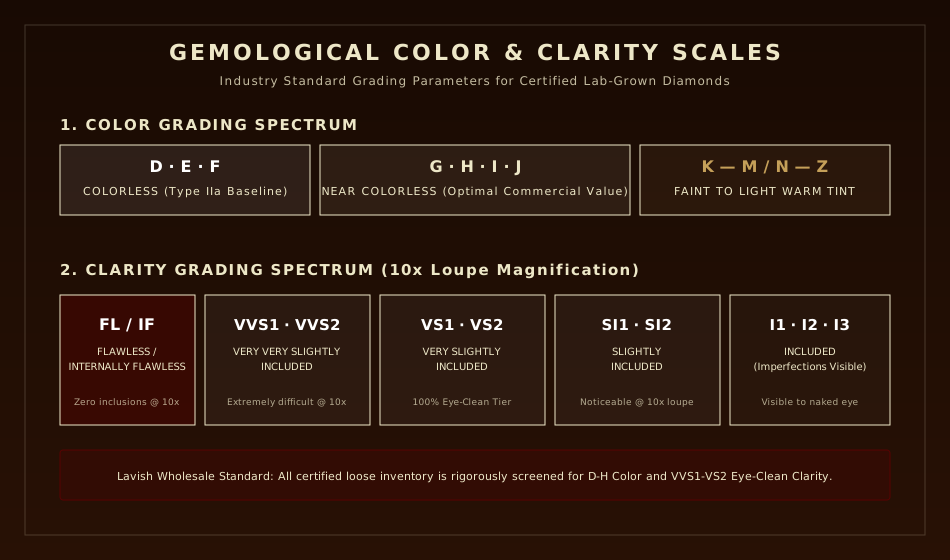
Figure 3.2: The Gemological Color & Clarity Grading Continuum
Color Grading: The D-to-Z Continuum
Diamond color grading evaluates how closely a diamond approaches pure colorlessness. In gemological laboratories, stones are graded face-down (table down) against a neutral white background under calibrated daylight-equivalent lighting (5500K to 6500K color temperature), comparing the stone against pre-certified "master color stones":
D Color: The absolute pinnacle of colorlessness. Extremely icy and crisp. Represents 100% light transmission without absorption.
E & F Color: Colorless. To the unaided human eye and even mounted in jewelry, E and F diamonds are indistinguishable from D color stones.
G & H Color: Top Near Colorless. Displays warm, bright white brilliance face-up. Exceptional commercial balance of price and beauty.
I & J Color: Near Colorless. Exhibits faint warmth when viewed from the profile or pavilion, but appears white when mounted face-up in yellow or rose gold.
K through Z Color: Faint to light yellow/brown tint. Outside standard luxury bridal demand unless intentionally chosen for vintage styling.
Two diamonds with the exact same certified "F" color grade can look noticeably different to a trained buyer. This is because standard 4Cs color grading measures saturation of tint, but not necessarily its specific hue (undertone):
Brown Undertones (CVD): Caused by localized vacancy clusters and non-diamond carbon bonds formed during rapid vapor growth. Inferior CVD stones may carry a faint muddy brownish cast that dulls brilliance. High-quality CVD diamonds undergo HPHT annealing to remove this tint completely.
Gray Undertones (CVD / HPHT): Caused by micro-graphitic inclusions or specific silicon-vacancy defect complexes, resulting in a steel-gray appearance.
Blue Nuance (HPHT): Caused by trace uncompensated boron atoms entering the HPHT metal flux during synthesis. While subtle blue nuance is not unattractive, it can make an F or G color stone appear unusually steely-blue.
At Lavish, our quality assurance protocols reject stones with visible brown, gray, or muddy undertones, ensuring only clean, crisp icy crystals enter inventory.
Clarity Scale & Inclusion Taxonomy
Clarity grading evaluates internal inclusions and external blemishes under 10x magnification. In lab-grown diamonds, common inclusion types include:
Pinpoints & Clouds
Microscopic dots of non-diamond carbon or tiny vacancy clusters. Isolated pinpoints are virtually imperceptible; dense clouds can cause slight localized haziness.
Metallic Flux Remnants
Exclusive to HPHT synthesis. Sub-microscopic droplets of iron, nickel, or cobalt alloy trapped as the crystal solidified. Appear as small reflective metallic crystals.
Feather Fractures
Microscopic internal cleavage cracks along the {111} crystallographic planes. Small feathers located away from the girdle have zero structural impact.
Growth Zoning & Strain
Subtle planar boundaries formed during cyclical vapor pulsing in CVD reactors, creating internal strain patterns visible under polarized filters.
Defining the "Eye-Clean" Threshold
In fine jewelry manufacturing, the golden rule of diamond selection is "Eye-Clean". A diamond is certified eye-clean when a person with 20/20 vision, viewing the diamond face-up at a standard viewing distance of 10 to 12 inches under diffused daylight, cannot detect any visible inclusions.
Virtually 100% of VVS1, VVS2, and VS1 lab-grown diamonds are guaranteed eye-clean. Approximately 95% of VS2 stones are eye-clean, making VS2 the premier commercial value tier in wholesale diamond buying. In SI1 stones, eye-clean status depends on the location and color of the inclusion (e.g., a white pinpoint hidden under crown facets is eye-clean, whereas a dark inclusion dead-center on the table facet is not).
help
Frequently Asked Questions
What is blue nuance in lab diamonds?expand_more
Blue nuance is a faint grayish-blue body cast occasionally found in HPHT lab diamonds caused by trace boron atoms entering the growth cell. Discerning buyers check certificate comments or physical stones to ensure pure white coloration.
Can a VS2 diamond look better than a VVS1 diamond?expand_more
Yes. If the VS2 diamond has an Ideal cut and D color, it will exhibit significantly more fire, brilliance, and scintillation than a poorly cut VVS1 stone with G color.
Are black inclusions in lab diamonds common?expand_more
In lower clarity grades (SI2–I1), small black inclusions composed of graphitic carbon or metallic flux may occur. In VS1 and VVS grades, inclusions are minute pinpoints that do not affect light transmission.
verified
Lavish Gemological & Technical Research Team
Technical Review: Senior Diamond Technologist & Quality Director
The universal language of diamond quality is the 4Cs—Cut, Color, Clarity, and Carat Weight. Established by the GIA and adopted globally by IGI, the 4Cs apply with equal scientific rigor to lab-grown diamonds, governing both visual brilliance and wholesale commercial value.
A diamond is an intricate optical prism. When light enters a diamond cut with mathematically ideal proportions, total internal reflection directs 100% of light back through the crown to the viewer’s eye, generating maximum fire and brilliance.
The International Gemological Institute (IGI) is the global gold standard for lab-grown diamond certification. This comprehensive guide walks you through every data field on an official IGI report—from 4Cs grading to proportion diagrams and vital growth comments.