Growth Technology • Comparative Technology

CVD vs HPHT Diamonds: Complete Comparative Analysis for Buyers

verified Lavish Gemological & Technical Research Team schedule 9 min read event Last Updated: October 2026
Both CVD and HPHT produce 100% genuine diamonds. However, their contrasting growth mechanics create distinct morphological traits, inclusion types, and internal strain profiles. Here is how professional wholesale buyers evaluate both synthesis methods.
lightbulb Key Gemological Takeaways
  • Finished Parity: Once cut and polished, a D-color VVS CVD diamond and a D-color VVS HPHT diamond look completely identical to the eye.
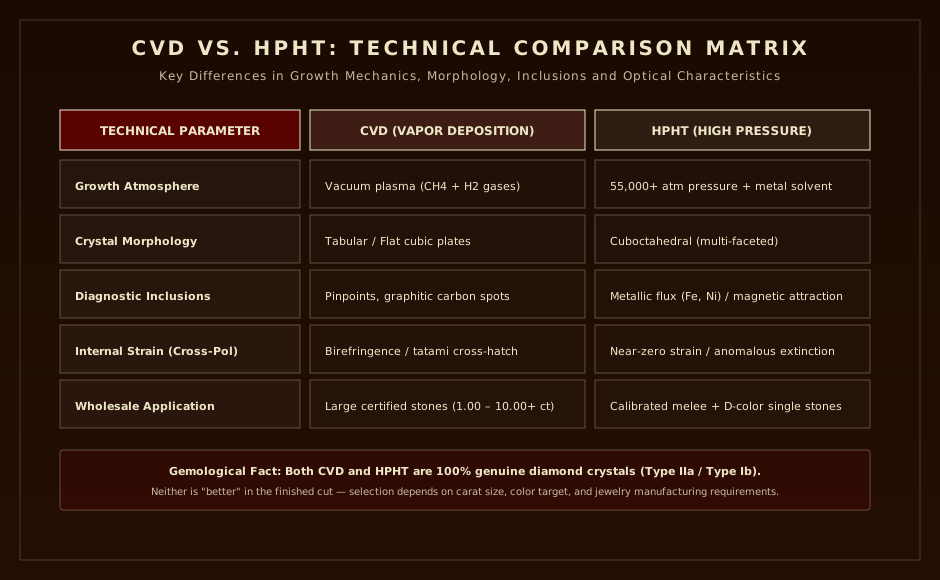
  • Rough Morphology: CVD crystals grow as tabular flat plates; HPHT crystals grow as cuboctahedrons with multiple crystal faces.
  • Diagnostic Inclusions: CVD diamonds contain graphitic pinpoints and clouds; HPHT diamonds may exhibit metallic flux remnants (Fe, Ni).
  • Strain Patterns (Birefringence): CVD diamonds display "tatami" cross-hatch strain patterns under cross-polarized light; HPHT diamonds exhibit very low strain.
  • Market Specialization: CVD dominates large certified single stones (1.00–10.00+ ct); HPHT dominates calibrated melee diamonds and fancy yellows/blues.
Figure 2.3: Structural & Gemological Comparison Matrix: CVD vs. HPHT Synthesis

Core Divergence: Plasma Deposition vs. High-Pressure Flux

In the laboratory diamond industry, two fundamentally distinct thermodynamic pathways are utilized to crystallize carbon atoms into diamond:

  • CVD (Chemical Vapor Deposition): Operates at low pressures (vacuum) and moderate temperatures (800°C–1,050°C). Gaseous carbon is deposited atom-by-atom onto a flat substrate plate, growing vertically.
  • HPHT (High Pressure High Temperature): Operates at colossal pressures (5.5–6.5 GPa) and extreme temperatures (1,400°C–1,600°C). Solid graphite dissolves in a pool of molten metal alloy and crystallizes onto seeds in three dimensions.

It is essential to understand that neither method is inherently "better". Both produce authentic Type IIa or Type Ib diamond crystals. However, understanding their subtle gemological differences allows jewelers and manufacturers to select the optimal stone for their specific application.

Rough Crystal Morphology & Cutting Yields

The shape of the uncut rough crystal directly dictates which finished cut shapes offer the highest weight yield:

CVD Tabular Plate Morphology

CVD rough grows as square or rectangular tabular plates with black graphitic rims. Because of their flat, blocky geometry, CVD crystals provide outstanding yields for fancy shapes—such as Emerald, Radiant, Cushion, Oval, and Princess cuts—as well as large Round Brilliants.

HPHT Cuboctahedral Morphology

HPHT rough crystallizes with multiple octahedral {111} and cubic {100} facets, closely resembling natural diamond crystal habits. This multi-faceted habit yields exceptionally balanced pyramids ideal for Round Brilliant cuts and small calibrated melee parcels.

Diagnostic Inclusion Profiles Under Magnification

Under a gemological microscope at 40x to 100x magnification, gemologists identify growth method by examining internal inclusion morphology:

  • CVD Inclusions: Characterized by non-diamond carbon pinpoints, tiny graphite clouds, irregular dark crystals, and localized micro-fractures. Metallic inclusions are completely absent because no metallic flux is used during CVD synthesis.
  • HPHT Inclusions: Characterized by microscopic remnants of the molten metal solvent (iron-nickel-cobalt). These appear as dark, metallic-reflective needles, droplets, or rod-like formations. In certain stones, these inclusions impart subtle magnetic properties.

Internal Strain Patterns & Cross-Polarized Filters

When viewed through a polariscope or cross-polarized optical filters, the internal atomic stress (birefringence) of the crystal becomes visible:

  • CVD Birefringence: Typically exhibits pronounced, multi-colored banded interference colors known as a "tatami" or cross-hatch strain pattern. This strain arises from minor atomic dislocations formed during rapid planar growth.
  • HPHT Birefringence: Generally displays very low internal strain or anomalous extinction patterns. Because HPHT growth occurs under quasi-hydrostatic pressure, the atomic lattice is uniformly compressed, leading to minimal optical strain.

Color Nuances: Brownish Undertones vs. Blue Nuance

In uncertified or poorly controlled synthesis, each method exhibits characteristic color tendencies that discerning wholesale buyers look for:

  • CVD Tint Tendency: As-grown CVD diamonds can exhibit a subtle brownish, grayish, or yellowish body undertone caused by carbon vacancy complexes. High-quality CVD diamonds undergo post-growth HPHT annealing to achieve crisp, icy D, E, and F colorless grades.
  • HPHT Tint Tendency: Early HPHT diamonds occasionally exhibited a faint grayish-blue body cast known as "blue nuance," caused by trace boron in the growth cell. Modern HPHT synthesis facilities utilize precise nitrogen and boron getter alloys to achieve pure D-color without any blue cast.

At Lavish, every certified loose diamond is individually inspected by our quality intake team to ensure 100% pure colorless brilliance free from unappealing brownish undertones or muddy blue nuance.

Wholesale Selection Guide: Which Should You Buy?

Jewelry Application Recommended Growth Primary Commercial Reason
Large Certified Solitaires (2.00–10.00+ ct) CVD (Annealed) High optical purity, superior yield in fancy shapes, large carat scalability.
Calibrated Star & Melee (0.80mm–3.50mm) HPHT Mass multi-seed cell yield, exceptional D-F color consistency, zero strain for micro-pavé setting.
Fancy Vivid Yellow Diamonds HPHT Controlled single substitutional nitrogen (Type Ib) yields saturated canary color without irradiation.
Fancy Pink & Red Diamonds CVD + Treatment CVD growth with nitrogen-vacancy (NV) center irradiation and low-temperature annealing.
help

Frequently Asked Questions

Is CVD better than HPHT? expand_more
Neither is inherently better. Both methods produce 100% genuine diamonds with identical hardness, fire, and durability. CVD is generally preferred for large certified single stones, while HPHT excels in calibrated melee and vibrant fancy colors.
Does an IGI certificate state whether a diamond is CVD or HPHT? expand_more
Yes. Official IGI and GIA laboratory grading reports explicitly disclose the growth process in the comments section, stating: "This Laboratory Grown Diamond was created by Chemical Vapor Deposition (CVD)" or "High Pressure High Temperature (HPHT)".
Do CVD and HPHT diamonds cost the same wholesale? expand_more
In current wholesale markets, CVD and HPHT diamonds of identical 4Cs grades (e.g. 2.00 ct Round D/VVS2 Ideal) trade at virtually identical price-per-carat levels.
verified
Lavish Gemological & Technical Research Team
Technical Review: Senior Diamond Technologist & Quality Director
Published by Lavish Diamond Research Labs
Trade Inquiries
Source Certified Diamonds Direct from Surat
Continue Learning

Related Gemological Guides

View All 20 Guides arrow_forward
Growth Technology 8 min read

High Pressure High Temperature (HPHT) Diamond Growth Explained

HPHT diamond growth replicates the thermodynamic conditions of the Earth’s mantle. Inside massive hydraulic presses generating 60,000 atmospheres of pressure, molten metal solvent catalysts dissolve graphite and precipitate it onto diamond seeds as cuboctahedral crystals.

Read Guide arrow_forward
Shapes & Manufacturing 8 min read

Calibrated Star and Melee Diamonds: Sieve Sizing and Pavé Selection

In fine watchmaking and micro-pavé jewelry manufacturing, calibrated star and melee diamonds provide the luminous foundation. Learn how precision sieve sorting, millimeter tolerances, and color/clarity parcel grading streamline high-volume production.

Read Guide arrow_forward