Chemical Vapor Deposition (CVD) Diamond Growth: Reactor Chemistry and Process
verified
Lavish Gemological & Technical Research Team schedule
9 min read event
Last Updated: October 2026
Chemical Vapor Deposition (CVD) represents the pinnacle of modern diamond synthesis. By ionizing methane and hydrogen gas in a low-pressure microwave plasma chamber, pure carbon atoms crystallize layer by atomic layer onto diamond substrate seeds.
lightbulbKey Gemological Takeaways
Low-Pressure Growth Mechanism: CVD operates at sub-atmospheric vacuum pressures (70–140 Torr), unlike mantle or HPHT pressures.
Microwave Plasma Dissociation: A 2.45 GHz microwave generator energizes process gases into a 1,000°C glowing plasma ball.
The Role of Atomic Hydrogen: Selectively etches away unwanted graphitic (sp2) carbon bonds while preserving pure diamond (sp3) crystal lattice.
Substrate Seed Matrix: Precision-polished single-crystal Type IIa seed plates provide the epitaxial atomic template for upward crystal growth.
Gemological Purity: CVD synthesis yields predominantly Type IIa diamonds with exceptional optical transparency and zero metallic inclusions.
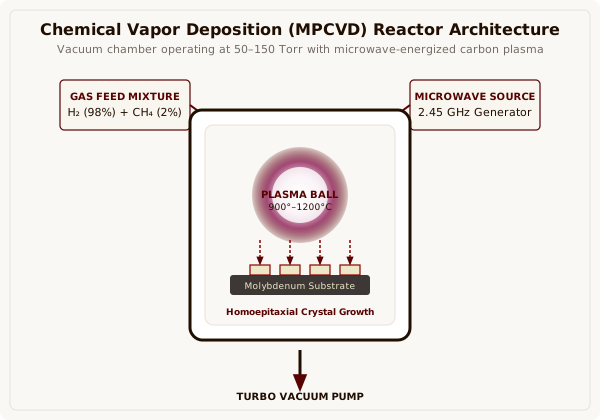
Figure 2.1: Schematic Cross-Section of a Microwave Plasma CVD Diamond Growth Reactor
Core Physical Principles of CVD Synthesis
Chemical Vapor Deposition (CVD) diamond growth fundamentally differs from geological mantle crystallization. Instead of applying extreme hydrostatic pressures (50,000+ atmospheres) to compress carbon into diamond, CVD operates at sub-atmospheric vacuum pressures—typically between 70 and 150 Torr (roughly 0.1 atmospheres).
Diamond is metastable at low pressures relative to graphite. Therefore, the scientific challenge of CVD is preventing carbon from forming stable graphite sheets. This challenge is overcome by creating non-equilibrium plasma conditions where gas-phase hydrocarbon molecules are thermally decomposed, and high concentrations of atomic hydrogen act as a selective chemical filter.
Process Gases & Plasma Chemistry (CH₄ + H₂)
Inside the stainless-steel CVD vacuum chamber, high-purity process gases are introduced at strictly controlled mass flow rates:
Methane (CH₄, 0.5% – 5% concentration): Serves as the primary carbon source. In the microwave plasma ball, methane molecules are bombarded by energetic electrons, stripping away hydrogen atoms to yield active methyl radicals ($CH_3^\bullet$) and carbon ions.
Hydrogen (H₂, 95% – 99.5% concentration): The critical catalyst in CVD diamond synthesis. Molecular hydrogen ($H_2$) dissociates in the plasma into atomic hydrogen ($H^\bullet$). Atomic hydrogen performs three vital functions:
It terminates open dangling carbon bonds on the growing diamond surface, preventing surface reconstruction into graphite.
It etches graphitic $sp^2$ bonded carbon thousands of times faster than it etches diamond $sp^3$ bonds, ensuring only diamond survives.
It abstracts surface hydrogen atoms, creating reactive radical sites where incoming methyl radicals can attach and form permanent covalent diamond bonds.
Trace Nitrogen / Oxygen (ppm level): Minute, controlled ppm additions of nitrogen can be introduced to accelerate growth rates, or oxygen to improve optical clarity.
Seed Preparation & Epitaxial Crystal Growth
CVD diamond cannot grow in mid-air; it requires a crystal template. Diamond substrate "seeds"—thin, square slices of high-purity single-crystal diamond (typically 10x10 mm or 12x12 mm)—are meticulously prepared. The seeds are laser-cut along the {100} crystallographic plane, polished to sub-nanometer surface roughness, and placed on a molybdenum substrate holder.
As methyl radicals settle on the seed crystal, carbon atoms lock into the established cubic lattice pattern. This process is known as homoepitaxial single-crystal growth. Growth proceeds upwards at rates between 8 and 25 micrometers per hour. Over a continuous cycle of 14 to 28 days, thick, tabular diamond crystal blocks ("pancakes") grow to heights of 6 to 12 millimeters, ready for laser sawing and faceting.
Reactor Engineering & Temperature Control
Modern CVD synthesis utilizes Microwave Plasma CVD (MPCVD) reactors powered by 2.45 GHz or 915 MHz industrial microwave generators operating at power outputs between 5 kW and 60 kW. The microwave energy is focused into the vacuum cavity, creating an intense electric field that ignites the gas into a hemispherical, violet-tinted plasma ball.
Substrate temperature must be maintained within a tight operational window—typically between 800°C and 1,050°C. Temperature is actively regulated via closed-loop chilled water cooling stages and monitored using dual-wavelength optical pyrometers. If the temperature drops too low, non-diamond carbon defects proliferate; if it climbs too high, graphite soot deposits rapidly destroy the run.
During rapid CVD diamond growth, isolated lattice vacancies and minor hydrogen-vacancy complexes can introduce a subtle brownish body tint into the as-grown rough crystal. To achieve top-tier D, E, and F colorless grades, manufacturers frequently subject as-grown CVD crystals to post-growth HPHT annealing.
The crystal is subjected to temperatures of 2,000°C to 2,400°C under stabilizing pressures exceeding 6 GPa for a brief duration. This thermodynamic treatment heals lattice vacancy defects and reorganizes atomic bonds, permanently eliminating brown undertones and restoring pristine Type IIa colorless transparency. On official IGI and GIA laboratory reports, this standard post-growth enhancement is fully disclosed in the comments section as: "May include post-growth treatment."
help
Frequently Asked Questions
What is the difference between CVD and HPHT growth?expand_more
CVD uses low-pressure gas plasma in a vacuum chamber to deposit carbon atoms onto diamond seeds layer by layer. HPHT uses extreme mechanical pressure (5.5+ GPa) and high heat (1,500°C) with molten metal solvent flux. Both create 100% genuine diamond crystals with distinct rough morphologies.
Why are most large single-stone lab diamonds grown by CVD?expand_more
CVD reactor chambers can accommodate large multi-seed substrate arrays without requiring colossal hydraulic anvil presses. This scalability makes CVD the most efficient method for growing large single-crystal diamonds from 1.00 ct up to 10.00+ carats.
Is post-growth HPHT treatment permanent in CVD diamonds?expand_more
Yes, 100% permanent. The high-temperature annealing permanently reorganizes the atomic carbon lattice and eliminates vacancy defects. The resulting colorless grade will never revert or fade over time.
verified
Lavish Gemological & Technical Research Team
Technical Review: Senior Diamond Technologist & Quality Director
HPHT diamond growth replicates the thermodynamic conditions of the Earth’s mantle. Inside massive hydraulic presses generating 60,000 atmospheres of pressure, molten metal solvent catalysts dissolve graphite and precipitate it onto diamond seeds as cuboctahedral crystals.
Both CVD and HPHT produce 100% genuine diamonds. However, their contrasting growth mechanics create distinct morphological traits, inclusion types, and internal strain profiles. Here is how professional wholesale buyers evaluate both synthesis methods.
A lab-grown diamond is 100% pure crystallized carbon arranged in an isometric-hexoctahedral crystal system. Physically, chemically, and optically identical to mined diamonds, lab diamonds are synthesized under meticulously controlled laboratory conditions replicating Earth’s mantle.