Certification & Identification • Laboratory Analysis

How to Read an IGI Diamond Report: Complete Specimen Analysis

verified Lavish Gemological & Technical Research Team schedule 8 min read event Last Updated: October 2026
The International Gemological Institute (IGI) is the global gold standard for lab-grown diamond certification. This comprehensive guide walks you through every data field on an official IGI report—from 4Cs grading to proportion diagrams and vital growth comments.
lightbulb Key Gemological Takeaways
  • IGI Global Leadership: IGI was the first major international laboratory to issue comprehensive 4Cs grading reports for lab-grown diamonds.
  • Mandatory Identification Header: Clearly states "LABORATORY GROWN DIAMOND" in bold lettering at the top of the report.
  • Report Number & QR Link: Every report features a unique 10-digit number and QR code resolving directly to IGI’s secure database.
  • Proportions Diagram: Details table percentage, total depth, crown angle, pavilion angle, and girdle thickness.
  • Crucial Comments Section: Discloses exact synthesis method (CVD or HPHT) and confirms Type IIa chemical purity.
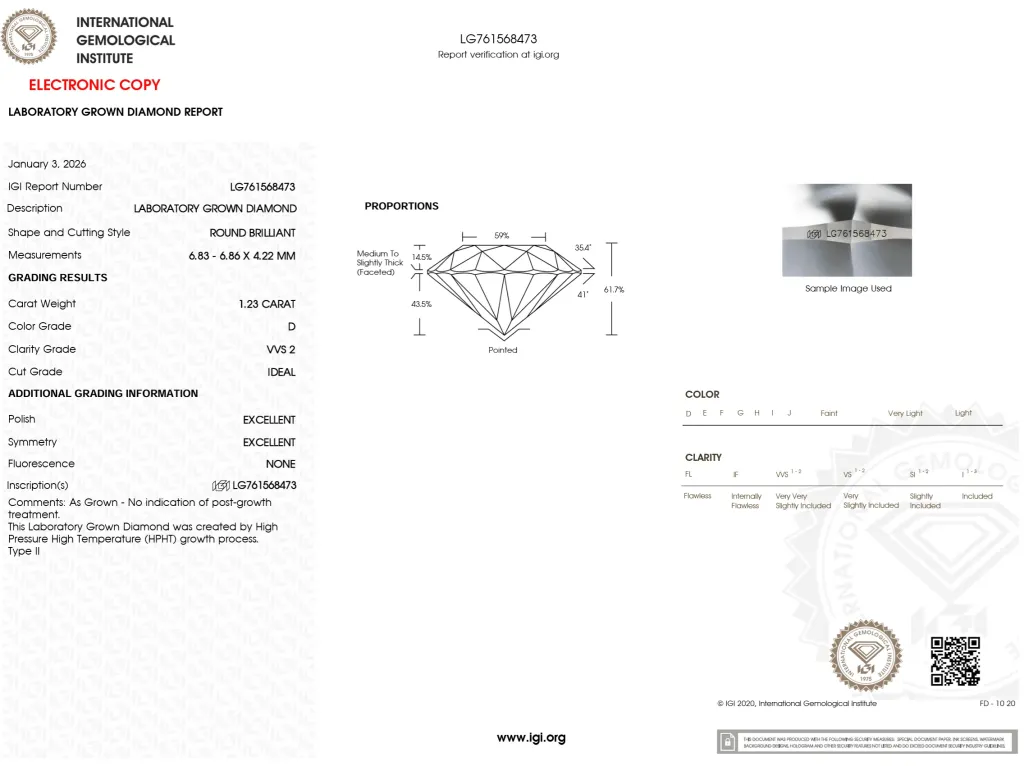
Figure 4.1: Official IGI Laboratory Grown Diamond Report Specimen (LG761568473 — 1.23 ct, D Color, VVS2, Ideal Cut, HPHT Type II)

Why IGI Certification is the Global Trade Standard

Established in Antwerp in 1975, the International Gemological Institute (IGI) operates 29 laboratory locations worldwide, including major diamond hubs in Antwerp, New York, Mumbai, Surat, Hong Kong, and Dubai. When lab-grown diamonds emerged commercially, IGI pioneered dedicated, full-spectrum 4Cs certification for lab stones while other legacy institutions hesitated.

Today, IGI certifies more than 85% of all certified loose lab-grown diamonds in global wholesale commerce. An IGI report is an internationally recognized guarantee of authenticity, providing an impartial, third-party scientific audit of a diamond’s optical and physical credentials.

Section 1: Report Header & Specimen Identification

At the very top of the certificate, IGI clearly establishes the stone’s origin, baseline identity, and laboratory registration details. Below is an authentic representation of the official specimen (Report No. LG761568473):

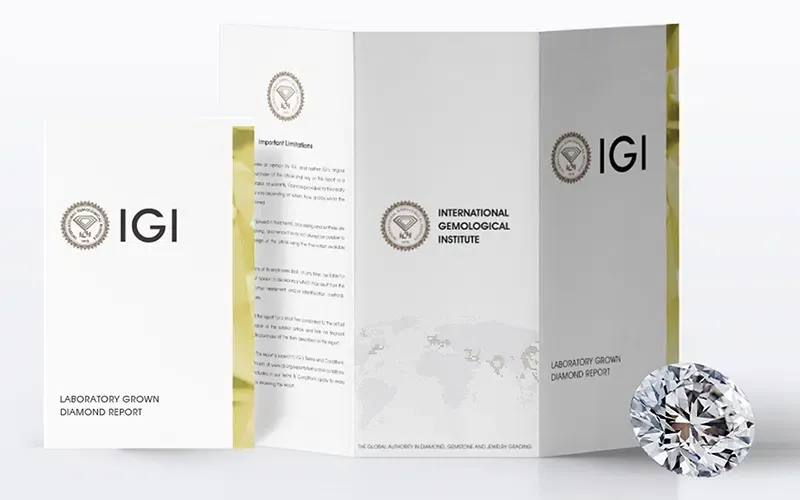
Official IGI Tri-Fold Report Presentation Folder with Loose Diamond Specimen
Physical Authentication

Official IGI Presentation Folio

In international diamond commerce, the physical certificate is delivered in an official IGI security trifold folio. The loose diamond specimen is inspected, weighed, and sealed alongside the report or mounted for delivery.

Specimen Inscription: IGI LG761568473
Figure 4.2: Official IGI Laboratory folder presented with the certified Round Brilliant diamond specimen.
Specimen Identification Fields Report # LG761568473
Report Number & Date: LG761568473 • January 3, 2026

The "LG" prefix officially designates "Laboratory Grown" in the international IGI global database.

Mandatory Description Header: LABORATORY GROWN DIAMOND

FTC-compliant mandatory declaration confirming 100% crystallized carbon created via technological synthesis.

Shape and Cutting Style: ROUND BRILLIANT

Specifies the faceting architecture (57 facets) calibrated for maximum optical reflection.

Calibrated Physical Measurements: 6.83 – 6.86 × 4.22 MM

Minimum diameter (6.83 mm), maximum diameter (6.86 mm), and total depth (4.22 mm) measured by non-contact 3D laser scanner.

Section 2: 4Cs Grading Results

The center-left block of the IGI certificate details the four fundamental gemological parameters (the 4Cs). Specimen LG761568473 achieves a virtually flawless grading tier:

Carat Weight
1.23 ct
Calibrated Microbalance
Color Grade
D
100% Completely Colorless
Clarity Grade
VVS 2
Microscopic Inclusions Only
Cut Grade
IDEAL
Top Light Performance Tier

Carat Weight Analysis: 1.23 Carats represents an optimal balance between visual presence (over 6.8 mm face-up spread) and pricing value, avoiding steep whole-carat retail price cliffs.

Color Grade D: The absolute highest colorless classification on the international diamond scale. Under standardized D65 daylight equivalent illumination, the diamond exhibits zero body tint or yellow nitrogen traces.

Clarity Grade VVS2: Very, Very Slightly Included. Inclusions in specimen LG761568473 are minute pinpoint crystals invisible to the naked eye and extremely difficult for a master gemologist to detect under 10× binocular magnification.

Cut Grade IDEAL: Reserved exclusively for Round Brilliant diamonds whose crown angle, pavilion angle, and table width align mathematically to maximize total internal light reflection.

Section 3: Proportions Plot & Finish Grades

On the right side of the certificate, IGI provides an exact cross-sectional proportions schematic alongside the optical finish grades. Every percentage on specimen LG761568473 falls strictly within the global Ideal Cut tolerance window:

Tolkowsky Proportions Analysis
Table Percentage: 59% (Ideal window: 54% – 60%)
Total Depth: 61.7% (Ideal window: 59% – 62.5%)
Crown Angle & Height: 14.5% • 35.4° (Optimal fire dispersion)
Pavilion Angle & Depth: 43.5% • 41.0° (Critical angle for light return)
Girdle Profile: Medium To Slightly Thick (Faceted)
Culet: Pointed (None) • Prevents center windowing
Optical Finish Grades
Polish: EXCELLENT

Facets are polished to a flawless mirror smoothness with zero abrasive wheel lines.

Symmetry: EXCELLENT

All 57 facet junctions align precisely across opposite axes without rotational displacement.

Fluorescence: NONE

Zero milky or hazy glow under 365 nm long-wave ultraviolet light.

Section 4: Growth Process Disclosure & Comments

The final section at the bottom of the IGI certificate contains critical technological and chemical declarations. Professional B2B buyers and diamond merchants inspect these exact statements on specimen LG761568473:

Laser Inscription Registry

Photomicrograph Girdle Inscription

IGI LG761568473

The certificate includes a dedicated photomicrograph reproducing the microscopic inscription etched onto the diamond's faceted girdle. This cold excimer UV laser inscription is non-destructive, permanent, and easily verified under a 10× or 20× jeweler loupe.

Synthesis & Purity Disclosure
Comments: "As Grown - No indication of post-growth treatment.
This Laboratory Grown Diamond was created by High Pressure High Temperature (HPHT) growth process.
Type II"
1. "As Grown" Status

Confirms the diamond emerged from the synthesis apparatus in its pure D-color state with no post-growth laser or irradiation color treatment required.

2. "HPHT Growth Process"

Identifies that the diamond was crystallized inside an ultra-high pressure hydraulic press replicating Earth mantle physics (60,000 atm, 1,500°C).

3. "Type II" Classification

The rarest chemical purity category (virtually zero nitrogen impurities). Type II diamonds represent under 2% of mined stones and produce exceptional optical transparency.

help

Frequently Asked Questions

Can an IGI certificate be faked? expand_more
Counterfeit printed certificates can exist, which is why Lavish recommends always verifying the certificate online via IGI’s official Verify Your Report portal (igi.org/verify) or scanning the QR code printed on the physical document.
Why does IGI specify "may include post-growth treatment"? expand_more
Because post-growth HPHT annealing leaves subtle spectral markers in CVD diamonds, IGI includes this standard disclosure to confirm that high-pressure heat was utilized to permanently optimize color to pure D, E, or F colorless grades.
Is an IGI report accepted by insurance companies worldwide? expand_more
Yes. IGI is an accredited international laboratory, and its grading reports are universally accepted by insurance adjusters, appraisal societies (ASA, NAJA), and fine jewelry retail networks globally.
verified
Lavish Gemological & Technical Research Team
Technical Review: Senior Diamond Technologist & Quality Director
Published by Lavish Diamond Research Labs
Trade Inquiries
Source Certified Diamonds Direct from Surat
Continue Learning

Related Gemological Guides

View All 20 Guides arrow_forward
Certification & Identification 8 min read

How to Verify an IGI Diamond Report and Laser Inscription

Trust in diamond commerce relies on verifiable chain-of-custody. Learn the 4-step intake protocol used by master gemologists and luxury ateliers to cross-reference an IGI grading report against the physical diamond in hand.

Read Guide arrow_forward
Certification & Identification 9 min read

How Gemological Laboratories Identify Lab-Grown Diamonds

Because cut lab-grown diamonds share identical physical, optical, and thermal properties with mined diamonds, gemologists use advanced spectroscopy and deep-UV fluorescence imaging to definitively identify growth origin and protect trade integrity.

Read Guide arrow_forward
Quality & The 4Cs 9 min read

The 4Cs of Lab-Grown Diamonds: B2B Grading and Valuation Guide

The universal language of diamond quality is the 4Cs—Cut, Color, Clarity, and Carat Weight. Established by the GIA and adopted globally by IGI, the 4Cs apply with equal scientific rigor to lab-grown diamonds, governing both visual brilliance and wholesale commercial value.

Read Guide arrow_forward