Lab-Grown Diamond Myths vs. Facts: 10 Misconceptions Debunked
verified
Lavish Gemological & Technical Research Team schedule
8 min read event
Last Updated: October 2026
Widespread misconceptions surround lab-grown diamonds. We debunk the top 10 myths with empirical gemological science, rigorous spectroscopy data, and official laboratory standards.
lightbulbKey Gemological Takeaways
Myth 1 Debunked: Lab diamonds are NOT synthetic simulants like Cubic Zirconia or Moissanite; they are 100% crystallized carbon.
Myth 2 Debunked: Lab diamonds do not get cloudy, dull, or fade over time; with Mohs 10 hardness, their sparkle lasts forever.
Myth 3 Debunked: A standard thermal diamond tester identifies lab diamonds as real diamond every time.
Myth 4 Debunked: Jewelers cannot differentiate them using a handheld 10x loupe; differentiation requires laboratory spectrometers.
Myth 5 Debunked: Major laboratories (IGI, GIA, HRD) issue identical 4Cs grading certificates for lab diamonds.
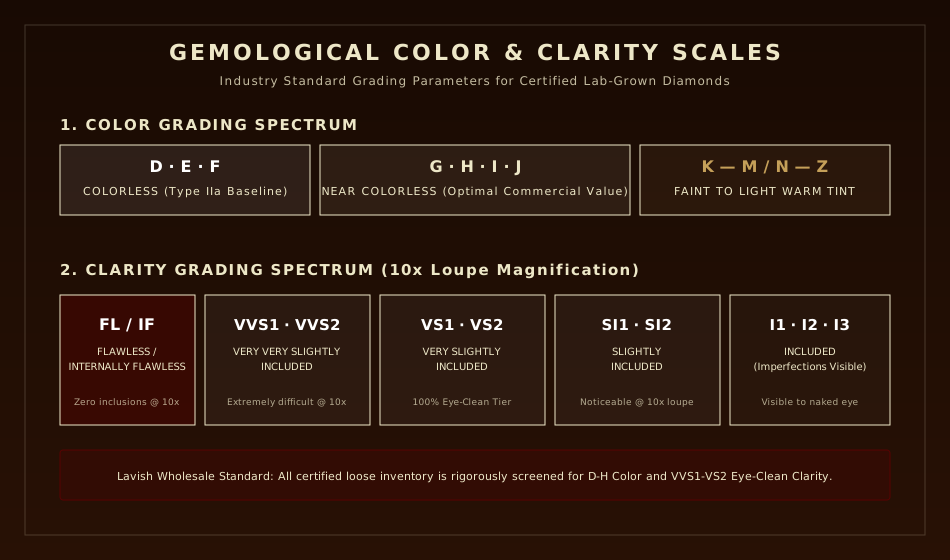
Figure 1.4: Industry Standard 4Cs Grading Scale Applied to Certified Lab Diamonds
Myth 1: Lab Diamonds Are Fake or Imitation Stones
The Myth: Lab-grown diamonds are synthetic simulants, comparable to Cubic Zirconia (CZ) or glass paste.
The Gemological Fact: False. Cubic Zirconia is synthesized zirconium dioxide (ZrO₂); Moissanite is silicon carbide (SiC). A lab-grown diamond is 100% pure elemental carbon crystallized in an isometric lattice. It possesses identical chemical formula, density (3.52 g/cm³), refractive index (2.417), and hardness (10 Mohs) as earth-mined diamonds. As legally codified by the US FTC, lab diamonds are authentic diamonds.
Myth 2: Lab Diamonds Fade, Cloud, or Discolor Over Time
The Myth: After months or years of wear, lab diamonds turn cloudy, lose their brilliance, or discolor.
The Gemological Fact: Scientifically impossible. Clouding in simulants like CZ occurs because CZ has a low surface hardness (8 Mohs) and absorbs skin oils, lotions, and micro-scratches. Diamond is the hardest substance known to man (10 Mohs). Its surface cannot be scratched by household wear or atmospheric exposure. A lab diamond will remain as intensely brilliant in 500 years as the day it was faceted.
Myth 3: Jewelers Can Easily Spot a Lab Diamond with a Loupe
The Myth: Any experienced jeweler can glance through a 10x loupe and instantly identify a lab diamond.
The Gemological Fact: Completely untrue. Even master gemologists cannot distinguish a high-quality lab diamond from a natural diamond through a microscope. Both stones exhibit identical facet junctions, light paths, and optical dispersion. The only element visible under 10x magnification is the microscopic laser inscription on the girdle reading "LAB GROWN" or "LG" followed by the certification report number.
Myth 4: Lab Diamonds Fail Diamond Testers
The Myth: Inexpensive thermal diamond pens will buzz red or label lab diamonds as "fake."
The Gemological Fact: Lab diamonds pass standard thermal and electrical conductivity testers 100% of the time. Because diamond’s thermal conductivity (~2000 W/m·K) is an intrinsic property of the $sp^3$ carbon lattice, the tester detects the stone as genuine diamond. (Note: In rare cases involving certain HPHT diamonds with trace boron, an electrical tester may indicate Moissanite; dual-probe testers or spectroscopic instruments instantly confirm diamond authenticity).
Myth 5: Lab Diamonds Have No Official Certification
The Myth: Lab diamonds only come with vendor certificates without independent laboratory verification.
The Gemological Fact: The vast majority of loose lab diamonds in wholesale commerce are certified by the International Gemological Institute (IGI), the world’s leading grading authority for lab-grown diamonds, or the GIA. These reports grade Cut, Color, Clarity, Carat Weight, proportions, and include a QR verification code linked directly to the laboratory’s public registry.
Myth 6: All Lab Diamonds Are Internally Flawless
The Myth: Because they are grown in a lab, all lab diamonds emerge perfect without any inclusions or flaws.
The Gemological Fact: Lab diamonds undergo natural crystal nucleation and growth kinetics. During synthesis, tiny graphite pinpoints, feather fractures, metallic flux remnants, or crystal twinning planes can form within the crystal. Consequently, lab diamonds span the full clarity grading spectrum from Flawless (FL) and Internally Flawless (IF) down to Included (I1-I3).
Myth 7: Lab Diamonds Lack Natural Fire and Brilliance
The Myth: Natural diamonds possess a special "organic glow" that lab diamonds cannot replicate.
The Gemological Fact: Brilliance (white light reflection), fire (spectral rainbow dispersion), and scintillation (facet sparkle) are governed exclusively by diamond optical physics: 2.417 refractive index, 0.044 dispersion fire, and precision cut proportions. An Ideal-cut lab-grown diamond displays equal or superior light performance compared to a mined stone of identical cut specifications.
Myth 8: Lab Diamonds Are Fragile and Chip Easily
The Myth: Because lab diamonds grow rapidly, their atomic bonds are weaker and more prone to chipping.
The Gemological Fact: Covalent carbon-to-carbon bond energies in a lab-grown diamond are identical to mined diamond (347 kJ/mol). Both share identical octahedral cleavage planes {111}. When set in jewelry, a lab diamond withstands daily wear, ring sizing torches, and ultrasonic cleaning with identical durability.
Myth 9: Lab Diamonds Are Mass-Produced in Seconds
The Myth: Growing a diamond takes minutes in a factory like stamping plastic toys.
The Gemological Fact: Growing gem-quality diamond crystals requires weeks of continuous synthesis under extreme vacuum or hydraulic pressure. A typical 2.00 to 3.00-carat rough crystal takes 2 to 4 weeks in a microwave plasma reactor, followed by days of precision 3D rough laser mapping, sawing, and master artisan faceting.
Myth 10: Lab Diamonds Have No Resale or Commercial Value
The Myth: Once purchased, a lab diamond is worthless on the secondary trade market.
The Gemological Fact: A multi-billion dollar global B2B trade infrastructure exists for loose certified lab-grown diamonds. Wholesalers, jewelry manufacturers, and trade exchanges actively trade, memo, and purchase certified lab diamond parcels daily based on current market replacement indices.
help
Frequently Asked Questions
Can lab diamonds be set into fine jewelry settings?expand_more
Yes. Lab diamonds are identical in durability to mined diamonds and can be set into platinum, 18K gold, 14K gold, and micro-pavé settings by any professional bench jeweler using standard setting techniques.
Do lab diamonds come with laser inscriptions?expand_more
Yes. Certified lab diamonds graded by IGI or GIA feature a microscopic laser inscription on the girdle reading "LAB GROWN" or "LG" followed by the report number, visible only under 10x to 20x magnification.
Can a jeweler refuse to work on a lab diamond?expand_more
Bench jewelers handle lab diamonds with identical procedures and heat tolerances as mined diamonds. Because the physical properties are identical, working on a lab diamond carries zero technical difference.
verified
Lavish Gemological & Technical Research Team
Technical Review: Senior Diamond Technologist & Quality Director
A lab-grown diamond is 100% pure crystallized carbon arranged in an isometric-hexoctahedral crystal system. Physically, chemically, and optically identical to mined diamonds, lab diamonds are synthesized under meticulously controlled laboratory conditions replicating Earth’s mantle.
Scientific reality: natural and lab-grown diamonds are physically, chemically, and optically identical. Understanding the differences comes down to origin, formation timeline, environmental footprint, and commercial wholesale economics.
The International Gemological Institute (IGI) is the global gold standard for lab-grown diamond certification. This comprehensive guide walks you through every data field on an official IGI report—from 4Cs grading to proportion diagrams and vital growth comments.