Diamond Fundamentals •
Industry Historical Timeline
History & Evolution of Lab-Grown Diamonds: 1954 to Present
verified
Lavish Gemological & Technical Research Team schedule
7 min read event
Last Updated: October 2026
The quest to synthesize diamond spans over seven decades. From General Electric’s high-pressure press in 1954 to microwave plasma CVD reactors and Surat’s state-of-the-art cutting facilities, discover how diamond synthesis evolved into a multi-billion dollar luxury industry.
lightbulbKey Gemological Takeaways
1954 GE Breakthrough: Dr. H. Tracy Hall achieved the first reproducible diamond synthesis under Project Superpressure.
Industrial Origins: Early synthetic diamonds were microscopic grit utilized for abrasive machining and drilling.
1980s NIRIM CVD Leap: Japanese researchers developed microwave plasma CVD, decoupling diamond growth from extreme hydraulic pressure.
2018 FTC Landmark Ruling: Removed "natural" from the official definition of diamond, confirming lab stones as genuine.
Surat Manufacturing Epicenter: Over 90% of global lab-grown diamonds are cut and polished by master artisans in Surat, India.
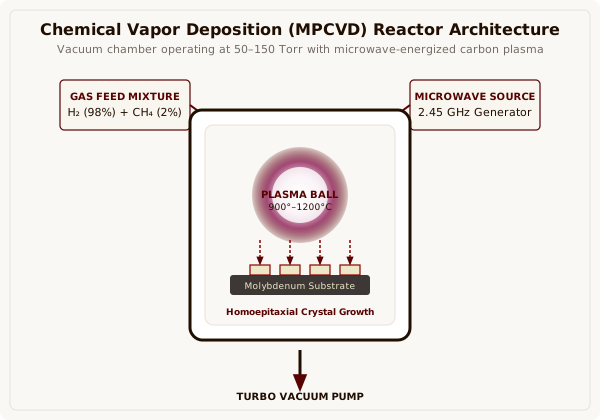
Figure 1.3: Modern Microwave Plasma CVD Reactor Architecture
Early Scientific Ambition & The 1954 GE Breakthrough
Ever since French chemist Antoine Lavoisier proved in 1772 that diamond is composed entirely of pure carbon by burning a diamond in a closed oxygen jar, scientists attempted to transform plentiful graphite into valuable diamond. Early attempts by Hannay (1880) and Moissan (1893) claimed success but proved scientifically irreproducible.
The definitive historical breakthrough took place on December 16, 1954, at the General Electric Research Laboratory in Schenectady, New York. Under "Project Superpressure," physical chemist Dr. H. Tracy Hall engineered the "Belt Press"—a revolutionary multi-anvil hydraulic apparatus capable of sustaining pressures over 100,000 atmospheres (10 GPa) and temperatures surpassing 1,600°C. Using a molten iron-nickel catalyst to break graphite carbon bonds, Hall synthesized the world’s first verified, repeatable diamond crystals.
The Industrial Abrasive Era (1960–1980)
During its first three decades, synthetic diamond was not focused on jewelry. The crystals produced were tiny, amber-colored grit and industrial powders. However, this material revolutionized modern heavy industry:
Diamond-tipped drill bits for oil, gas, and geological exploration.
Precision abrasive wheels for machining aerospace alloys and optics.
De Beers, recognizing the competitive potential of synthetic diamond, launched its own industrial synthesis subsidiary (Element Six) to supply global manufacturing demands.
The Japanese NIRIM CVD Revolution (1980s)
While HPHT dominated industrial synthesis, researchers in the Soviet Union (Derjaguin and Fedoseev) and the United States (William G. Eversole at Union Carbide) explored growing diamond at low pressures using gas-phase hydrocarbon decomposition.
The breakthrough came in the 1980s at Japan’s National Institute for Research in Inorganic Materials (NIRIM). Researchers led by Seiichiro Matsumoto demonstrated that microwave plasma Chemical Vapor Deposition (MPCVD) combined with excessive atomic hydrogen could selectively etch away graphite while allowing pure diamond films to crystallize on single-crystal diamond substrates. This decoupled diamond growth from colossal hydraulic presses and paved the way for modern gem-quality crystal plates.
Emergence of Gem-Quality Single Crystals (2000–2015)
By the early 2000s, pioneering companies such as Gemesis (HPHT) in Florida and Apollo Diamond (CVD) in Massachusetts succeeded in growing single-crystal diamonds exceeding 1.00 carat with high clarity. Early stones often carried yellow tints (HPHT nitrogen) or brownish body undertones (CVD non-diamond carbon defects), requiring high-pressure post-growth annealing.
Over the next decade, reactor precision improved exponentially. Gas purity exceeded 99.9999%, plasma temperatures were stabilized with multi-spectral optical pyrometry, and growth rates achieved 10 to 20 micrometers per hour. Pure, untreated D-F color, VVS-clarity rough crystals became commercially achievable at scale.
FTC Modernization & Global Commercial Boom (2018–Present)
The turning point for the global luxury market arrived in July 2018, when the US Federal Trade Commission formally revised its jewelry guidelines, cementing lab diamonds as authentic diamonds. That same year, major international grading labs rolled out comprehensive digital grading certificates for lab stones.
Concurrently, the manufacturing landscape consolidated. Surat, India—the historic diamond cutting capital of the world—established cutting-edge laser cutting and automated polishing infrastructure dedicated to lab-grown diamonds. Today, India produces and polishes over 90% of global certified loose lab-grown diamond inventory, powering global retail fine jewelry houses.
help
Frequently Asked Questions
Who was the first person to synthesize a diamond?expand_more
Dr. H. Tracy Hall at General Electric successfully synthesized the first repeatable, verified lab-grown diamond on December 16, 1954, using a proprietary hydraulic Belt Press capable of 100,000 atmospheres of pressure.
When did lab-grown diamonds enter the fine jewelry market?expand_more
While experimental gem-quality stones appeared in the early 2000s through companies like Gemesis and Apollo Diamond, mass-market commercial adoption began in earnest around 2016 to 2018, accelerated by FTC regulatory updates and widespread IGI/GIA certification.
Why is India the epicenter for lab-grown diamond manufacturing?expand_more
Surat, India has been the global hub for diamond cutting and polishing for over five decades. Indian manufacturers rapidly adopted high-tech green energy synthesis facilities, advanced 4-axis laser sawing machines, and automated robotic faceting benches, providing unmatched wholesale scale and precision.
verified
Lavish Gemological & Technical Research Team
Technical Review: Senior Diamond Technologist & Quality Director
Chemical Vapor Deposition (CVD) represents the pinnacle of modern diamond synthesis. By ionizing methane and hydrogen gas in a low-pressure microwave plasma chamber, pure carbon atoms crystallize layer by atomic layer onto diamond substrate seeds.
HPHT diamond growth replicates the thermodynamic conditions of the Earth’s mantle. Inside massive hydraulic presses generating 60,000 atmospheres of pressure, molten metal solvent catalysts dissolve graphite and precipitate it onto diamond seeds as cuboctahedral crystals.
A lab-grown diamond is 100% pure crystallized carbon arranged in an isometric-hexoctahedral crystal system. Physically, chemically, and optically identical to mined diamonds, lab diamonds are synthesized under meticulously controlled laboratory conditions replicating Earth’s mantle.